

We offer a wide range of enthalpy heat exchangers for most heat recovery ventilation units.
If you can't find the right model, contact us – we'll be happy to help!


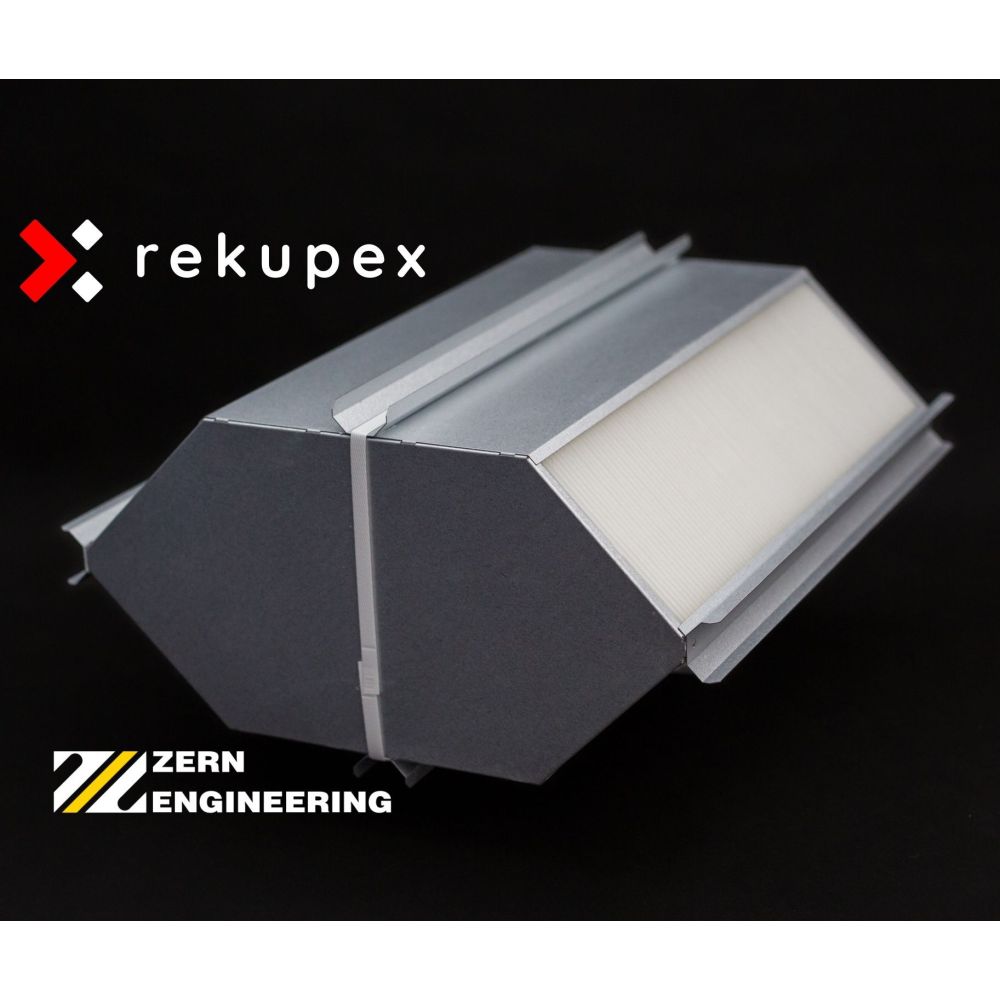
Premium replacement enthalpy heat exchanger from the ZERN EC-EX series, fully compatible with Viessmann Vitovent 300-W (400 m³/h, H32S B400) units. It ensures highly efficient heat and moisture recovery thanks to a unique polymer membrane.
This high-performance enthalpy heat exchanger from the ZERN EC-EX series is designed as a fully compatible replacement for Viessmann Vitovent 300-W (400 m³/h, H32S B400) heat recovery units. Thanks to its innovative design, it ensures effective recovery of both heat and moisture, representing a premium and full-fledged alternative to the original exchanger.
Warning: The product is a high-quality alternative from an independent manufacturer. We pride ourselves on precision – if we have any doubts about the correctness of your selection, we will contact you before shipping to verify compatibility with your Viessmann unit together.
COMFORTABLE CLIMATE: ZERN EC-EX series exchangers maintain a comfortable indoor environment even in dry winter months thanks to the recovery of latent heat from water vapor, thereby preventing the drying out of mucous membranes and wooden interior furnishings.
ZERN EC-EX exchangers utilize an optimized lamella geometry to maximize heat and moisture transfer while maintaining minimal pressure drop:
| Component | Technical benefit |
|---|---|
| Polymer membrane | Selective permeability of water molecules; impermeable to impurities and odors. |
| HPS casing | High mechanical strength and precise fit in the shaft of the Viessmann Vitovent 300-W (400 m³/h, H32S B400) unit. |
Interested in a technology comparison? Check out our detailed comparison of enthalpy heat exchangers from different manufacturers.
Have more questions? Find answers to the most common queries in our Frequently Asked Questions (FAQ) section.
"The ZERN EC-EX series exchangers represent a modern generation of enthalpy cores that combine high hygiene standards with efficient latent energy recovery."
The exchanger has the exact same dimensions as standard exchangers in Viessmann Vitovent 300-W (400 m³/h, H32S B400) units. Replacement is a direct swap process without the need for any mechanical modifications.
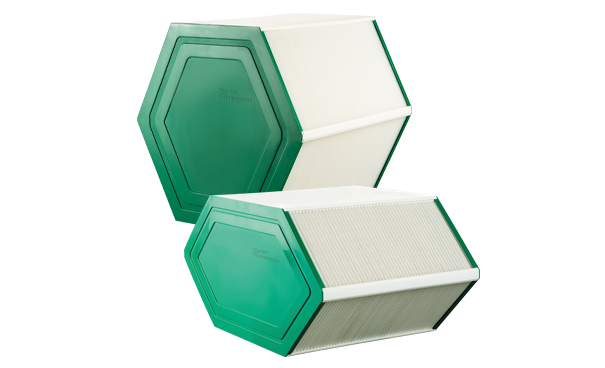
ZERN EC-EX enthalpy heat exchanger series
Can the ZERN EC-EX exchanger be cleaned?
Yes, the exchanger is washable. Clean it by rinsing with lukewarm water (up to 30°C). Never use high-pressure cleaners, as this could damage the membrane.
Does the exchanger transfer odors?
No. The unique ZERN polymer membrane is designed to allow only water molecules to pass through. Odors, gases, and microorganisms are blocked by the membrane.
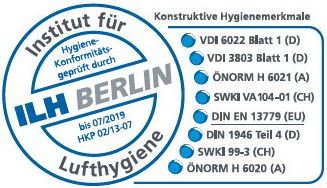

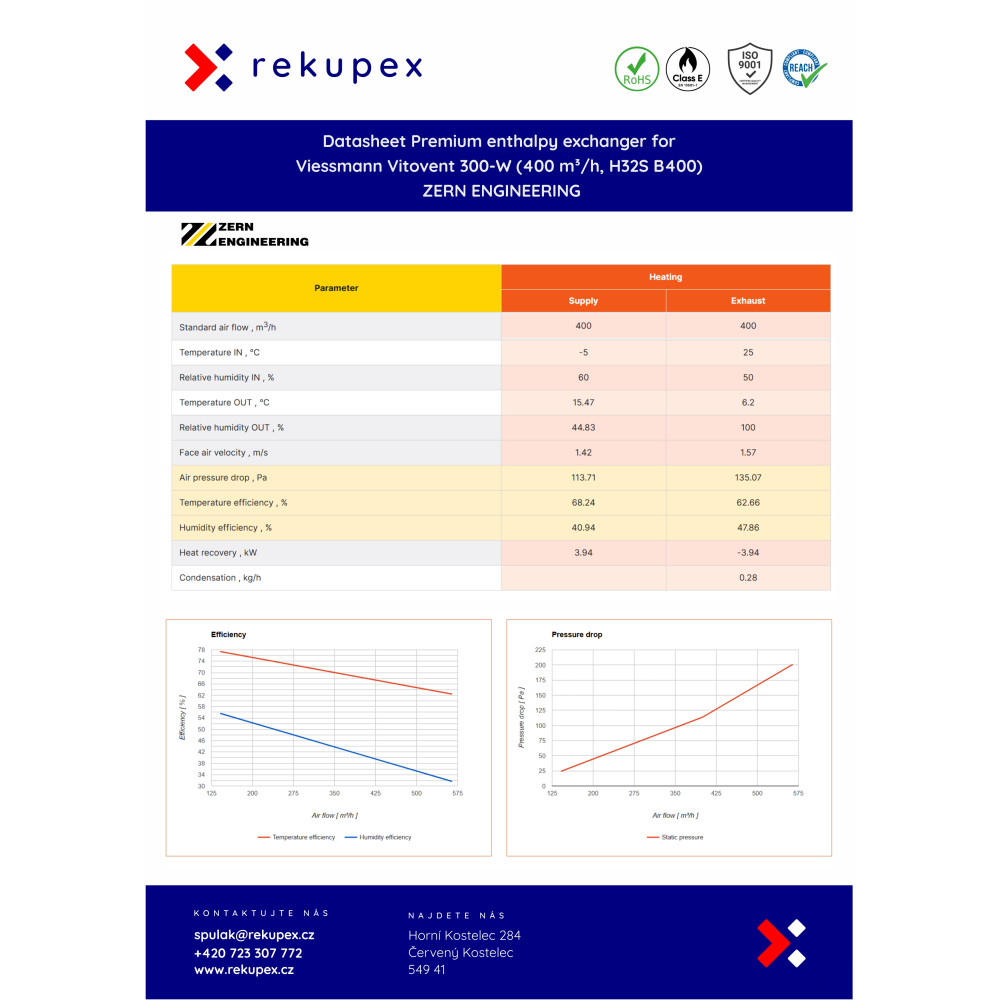
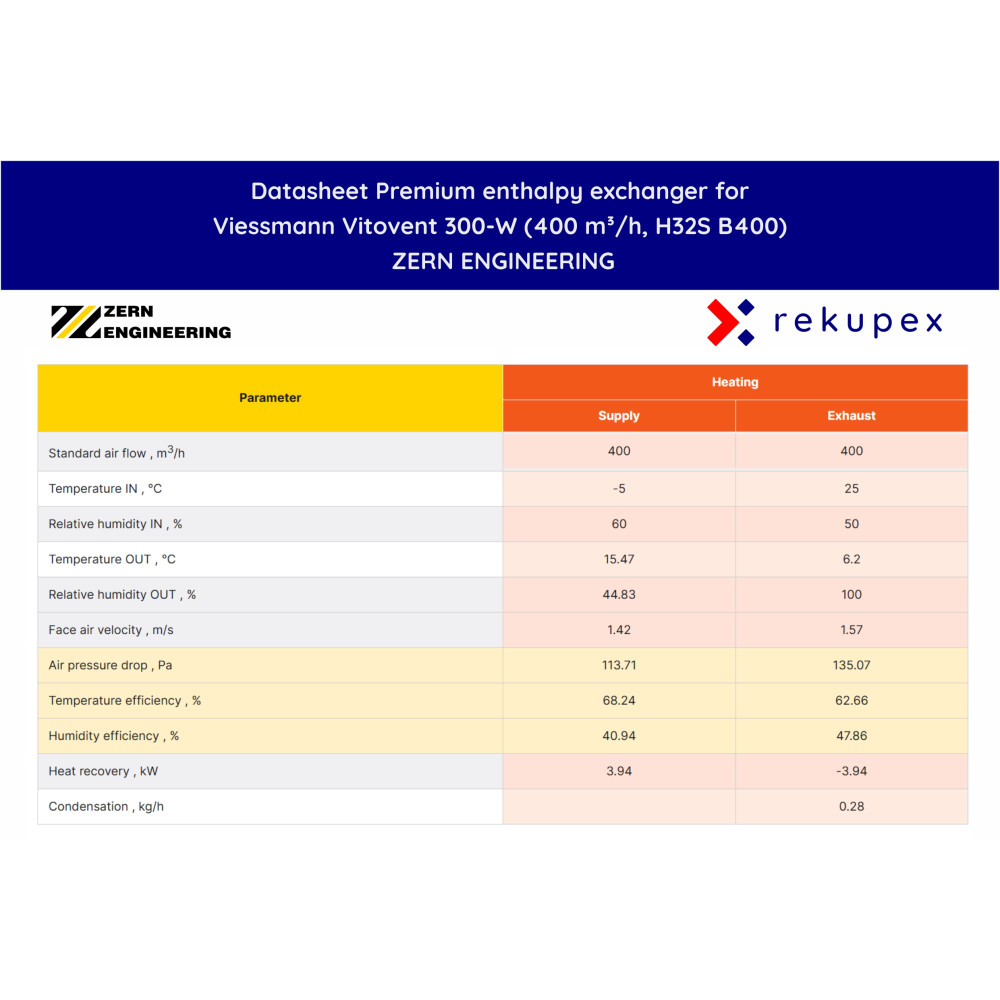
Data sheet
Specific References
At Rekupex, we offer enthalpy heat exchangers for a wide range of ventilation units from various manufacturers. We continuously expand our range to cover as many commonly used ventilation systems on the market as possible.
Our customers also play an important role in expanding the product range by helping us identify new types of ventilation units and their compatible enthalpy heat exchangers. Thanks to this cooperation, we can continuously develop our offer and adapt it to the real needs of users. Thank you for your feedback and suggestions.
To make it easier for you to understand the differences between enthalpy exchangers from RECUTECH, ZERN Engineering, CORE, and AIRWOODS, we have prepared a clear technical comparison of exchangers of the same size 366 × 366 × 400 mm, which can be directly compared thanks to their identical dimensions.
The overview also includes three key diagrams, which make it possible to compare exchanger behavior depending on the air volume flow rate:
Click on the diagram to open the high-resolution detail.
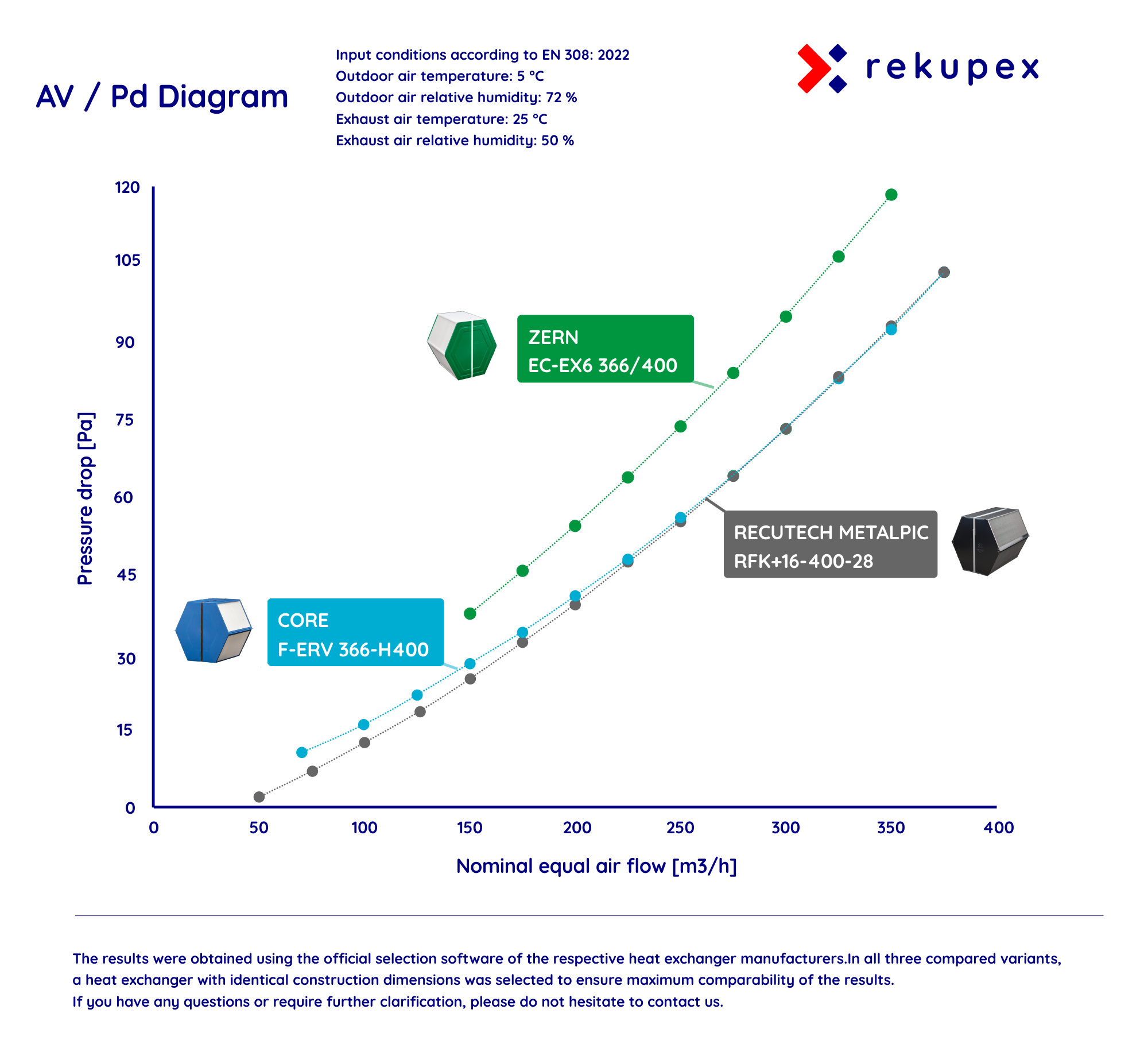
Pressure drop vs. air volume flow rate
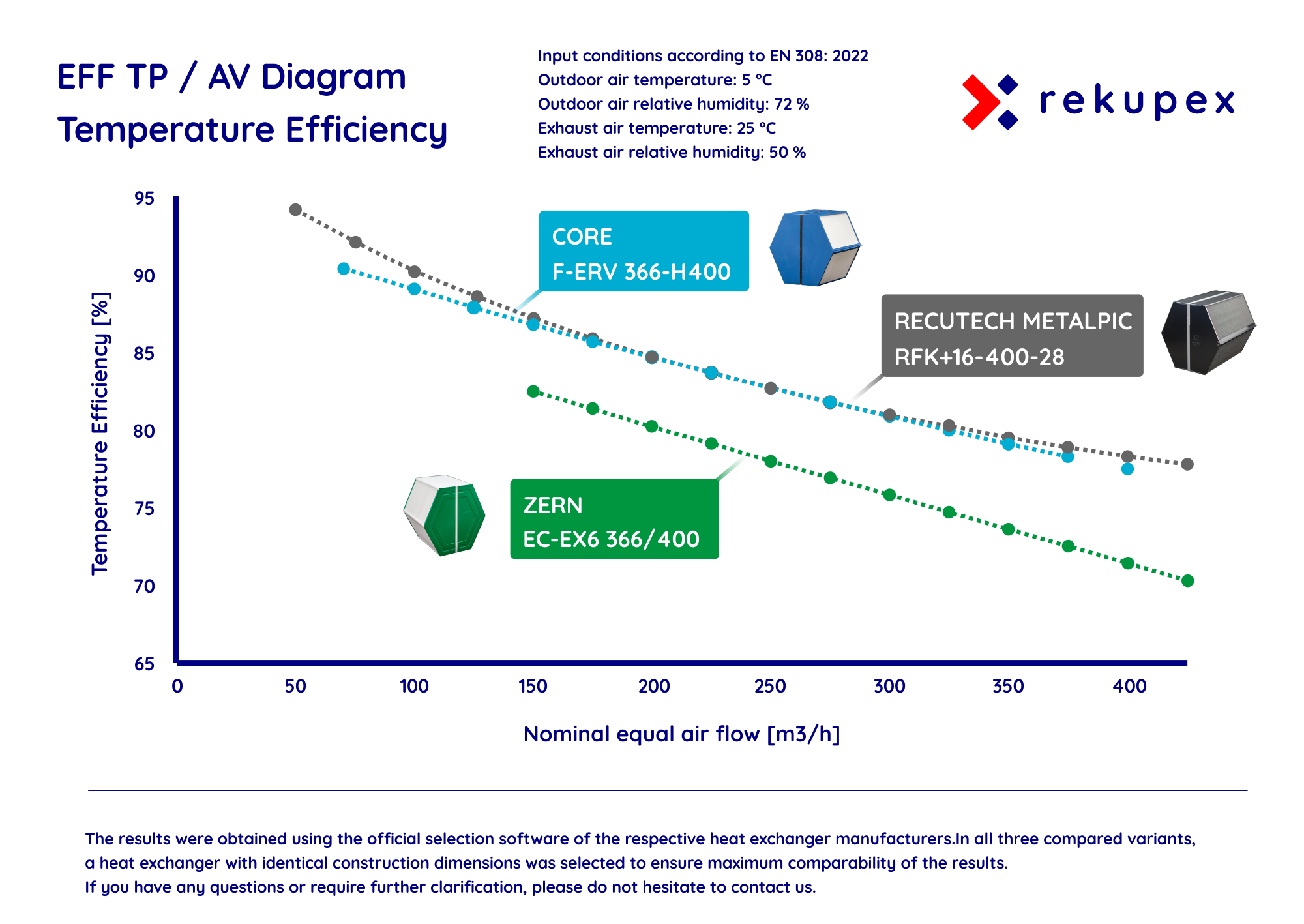
Heat transfer efficiency
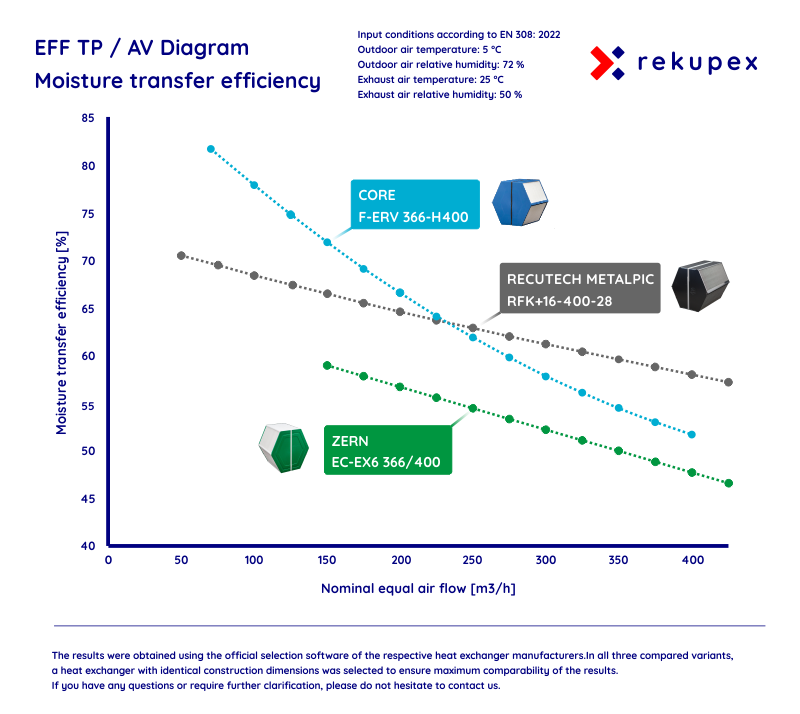
Moisture transfer efficiency
Input conditions according to EN 308:2022
The results were obtained using the selection and design software of the individual manufacturers.
The input parameters are unified according to EN 308:2022, unless stated otherwise. For AIRWOODS, different input values according to the manufacturer’s documentation were used, therefore the inputs differ.
On mobile, swipe the table sideways.
| Parameter | CORE F-ERV 366 | ZERN EC-EX6 366 | RECUTECH METALPIC RKF+16 | AIRWOODS WXL-LB 366* |
|---|---|---|---|---|
| Exchanger photo |  |
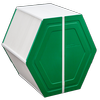 |
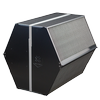 |
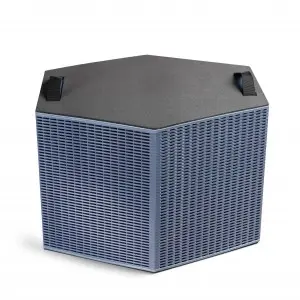 |
| Input conditions | ||||
| Outdoor air temperature [°C] | 5 | 5 | 5 | -5 |
| Outdoor air relative humidity [%] | 72 | 72 | 72 | 25 |
| Extract air temperature [°C] | 25 | 25 | 25 | 25 |
| Extract air relative humidity [%] | 50 | 50 | 50 | 80 |
| Performance at air volume flow rate of 150 m³/h | ||||
| Pressure drop [Pa]¹ | 28 | 37,65 | 25,18 ⭐ best | 29,9 |
| Temperature efficiency [%]¹ | 84,1 | 82,36 | 87,1 ⭐ best | 85,75 |
| Moisture efficiency [%]¹ | 70,9 | 58,96 | 66,5 | 75,73 ⭐ best |
| Performance at air volume flow rate of 400 m³/h | ||||
| Pressure drop [Pa]¹ | 134 | 141 | 114 ⭐ best | – |
| Temperature efficiency [%]¹ | 77,5 | 71,4 | 78,3 ⭐ best | – |
| Moisture efficiency [%]¹ | 51,7 | 47,84 | 58 ⭐ best | – |
| Construction and materials | ||||
| Exchanger casing material | Unspecified plastic | HPS (High Pressure Structure) | Corrosion-resistant aluminum | Unspecified plastic |
| Exchanger construction type | Polymer plate exchanger | Polymer plate exchanger | Metal enthalpy heat exchanger ⭐ | Polymer plate exchanger |
| Enthalpy membrane carrier | The membrane is part of the supporting material | HPS (High Pressure Structure) | Aluminum carrier (expanded metal) | Plastic separators |
| Type of enthalpy membrane | Formable polymer membrane (integrated in the plates) | Polymer microporous membrane | Ion-exchange membrane (METALPIC) | Polymer microporous membrane |
| Transport packaging | Polystyrene protection + cardboard box | Polystyrene protection + cardboard box | Wooden transport crate (also suitable for storing the original exchanger) | Polystyrene protection + cardboard box |
| REKUPEX evaluation | ||||
| Overall evaluation | High efficiency at lower flow rates. Thanks to its low weight and smooth casing, it places minimal demands on installation. | Robust and mechanically durable construction. Good availability of dimensions for a wide range of ventilation units. | All-aluminum exchanger with METALPIC membrane. Excellent efficiency / pressure drop ratio. Highest heat transfer efficiency and, at higher air volume flow rates, also very good moisture transfer. | Proven exchangers used by a number of European unit manufacturers thanks to a good price / performance ratio. |
| Strengths | Very good moisture efficiency at lower air flow rates. Low weight. | Very solid workmanship and high mechanical durability. | Very good results at medium and higher flow rates. Low pressure drop across the entire range. | Favorable price while maintaining solid parameters. |
| Possibility of adapting exchanger dimensions | Limited | Limited | Very wide possibilities for adapting dimensions ⭐ | Limited |
| Availability of newly identified and less commonly used exchangers | Limited availability | Good availability | Excellent availability ⭐ | Limited availability |
| Note about the manufacturer | – | – | RECUTECH provides excellent customer and technical support, making it possible to effectively design, adapt, and integrate exchangers into a wide range of ventilation units. Thanks to the robust construction with an aluminum casing, the exchangers are also very suitable for retrofit applications and modernization of older ventilation units. | – |
| Certification and compliance | ||||
| Eurovent | – | – | YES | – |
| DIN ISO 9001:2015 | YES | YES | YES | – |
| Hygiene certificate | VDI 6022 | VDI 6022 | VDI 6022 | ANTI BACTERIAL + Antimicrobial test report |
| RoHS | YES | YES | YES | YES |
| REACH | YES | YES | YES | YES |
| Data source and calculation | ||||
| Exchanger manufacturer | CORE GmbH | ZERN Engineering | RECUTECH | AIRWOODS |
| Availability (sales) | www.rekupex.cz | www.rekupex.cz www.rekupex.de |
www.rekupex.cz www.rekupex.de |
On request by e-mail: info@rekupex.cz |
| Calculated size | 366 × 366 × 400 mm | 366 × 366 × 400 mm | 366 × 366 × 400 mm | 366 × 366 × 400 mm |
| Calculation software | Online (manufacturer’s website) | Online (manufacturer’s website) | Offline design selector | Offline design selector |
| Calculation date | 3 March 2026 | 3 March 2026 | 3 March 2026 | 3 March 2026 |
⭐ best value in the given category
¹ The values were determined based on calculations in the manufacturers’ selection programs under the input conditions defined by EN 308:2022.
* Different input values according to the manufacturer’s documentation were used for AIRWOODS.
Based on our long-term experience with the design and integration of enthalpy heat exchangers into various types of ventilation units, we particularly recommend RECUTECH exchangers, which stand out thanks to their very good efficiency / pressure drop ratio, robust construction, and above all excellent technical support from the manufacturer.
Thanks to this cooperation, the exchangers can be easily adapted to a wide range of ventilation units, including retrofit installations in older equipment.
The comparison shows that individual manufacturers optimize their exchangers for different operating conditions. Some exchangers achieve very good results especially at lower air volume flow rates, while others are optimized for medium and higher air flow rates.
When choosing an enthalpy heat exchanger, it is therefore important to consider not only the efficiency itself, but also pressure drop, exchanger construction, compatibility with the ventilation unit, the possibility of adapting dimensions, and the availability of replacement exchangers.
What is the difference between an enthalpy heat exchanger and a standard heat recovery exchanger?
An enthalpy heat exchanger transfers not only heat, but also part of the moisture from the extract air to the supply air. This helps maintain a more comfortable indoor humidity level, especially during the winter season.
What is the typical efficiency of an enthalpy heat exchanger?
The temperature efficiency of modern enthalpy heat exchangers usually ranges approximately between 75–90 %.
The moisture transfer efficiency is usually lower and generally ranges approximately between 40–75 %.
Both values are significantly influenced by the exchanger design, membrane quality, and especially the air volume flow rate at which the exchanger is operated.
Can an enthalpy heat exchanger be installed in an older ventilation unit?
Yes, at RekupeX we not only sell exchangers, but also technically adapt them for specific ventilation units. We manufacture our own sealing and mounting profiles, and if necessary we also produce reduction casings. Thanks to this, we can offer an enthalpy replacement even for older ventilation units, where compatibility may at first glance appear problematic. A typical example is exchangers for Atrea units.
Note: The technical data and graphs presented in this overview were prepared based on the technical documentation of the individual manufacturers and the results of their selection or design tools. Although we have made every effort to ensure maximum accuracy, individual values may vary depending on the specific operating conditions, unit configuration, or updates to the data provided by the manufacturers.
The stated REKUPEX evaluation is based on our long-term practical experience with the design, sale, and integration of enthalpy heat exchangers into various types of ventilation units.
If any manufacturer identifies an inaccuracy or has a comment regarding the stated data, we will be grateful for the notice and will be happy to adjust the data.
If you are unsure which enthalpy heat exchanger is suitable for your ventilation unit, do not hesitate to contact us. We will be happy to help you choose the right solution.
No, never block the condensate drain.
Even though enthalpic heat exchangers produce only a minimal amount of condensate due to moisture transfer, in severe frost and specific humidity conditions, condensate can still occur. Blocking the drain could cause irreversible damage to your unit.
Since an enthalpic heat exchanger also transfers humidity, it might seem that the risk of mold is higher. In reality, however, all moisture is carried away with the fresh air, so there is no risk of mold growth.
Our recommendation is to never switch off the unit during the winter months, so that moisture is continuously removed. If you still need to shut down the unit, remove the exchanger, rinse it with clean water, dry it thoroughly, and only then reinstall it.
Yes, installation is simple. Just follow the instructions provided with your unit. As with a standard exchanger, it needs to be removed occasionally for cleaning – the process is the same, except that you put the enthalpic exchanger back in instead.
Feel free to contact us with any unit model. We will do our utmost to provide you with a 100% compatible exchanger, regardless of the type of ventilation unit you have.
In any case, the exchangers we supply are identical to the original parts used by the unit manufacturers, and in many cases, our exchangers are even of higher quality. However, we must clearly state that we are not official distributors of spare parts from the unit manufacturers. Transparency is very important to us.
An enthalpic heat exchanger should be used all year round. In winter, it prevents excessive drying of the indoor air, and in summer, it helps maintain comfortable humidity and temperature by reducing heat transfer and returning part of the moisture to the fresh supply air. This increases comfort and saves energy in every season.
No, caring for an enthalpic heat exchanger is no more demanding than for a standard one. Maintenance is described in the user manual and in our video guide. In short: first vacuum the exchanger with a soft brush attachment, then rinse it with clean water (max. 50 °C). Never use compressed air or a pressure washer.
After rinsing, allow all water to drain completely. Remaining moisture can be carefully blown out with a regular hairdryer, but always use cold air only. Once the exchanger is completely dry, place it back into the unit in the same orientation as before removal.
We do not recommend using chemicals for cleaning. Only if disinfection is absolutely necessary may a weak solution of peracetic acid (CH₃CO₃H) at 0.1–0.2% concentration be used, followed by very thorough rinsing with clean water.
Yes, the use of an enthalpic heat exchanger is completely safe. The membrane is designed to allow only water vapor molecules to pass through, while blocking bacteria, odors, and harmful substances. All enthalpic heat exchangers we offer are hygienically tested and certified.
An enthalpic heat exchanger will always help improve indoor humidity, as it transfers part of the moisture from exhaust air back into the fresh supply air. It cannot be guaranteed that ideal levels (typically 40–60%) will be achieved, since the final humidity also depends on other factors – such as household habits, number of occupants, natural moisture sources, and outdoor climate conditions.
We guarantee an improvement in humidity levels, as the recovery of moisture from exhaust air naturally increases indoor humidity.
The enthalpic plate works the same from both sides, so the orientation of the plate itself does not matter. However, it is essential that after cleaning the exchanger is always reinstalled in the same orientation, ensuring that the channels for fresh air remain for fresh air and the channels for exhaust air remain for exhaust air.
An enthalpic heat exchanger does not generate humidity – it maximizes the transfer of humidity from exhaust air into fresh supply air. If you previously used a standard exchanger, not only the air but also the building structure (walls, ceilings, floors) and porous materials became dry. This means it may take some time for humidity levels to recover, so patience is necessary.
Every enthalpic exchanger we supply is fully functional and improvement is guaranteed. We recommend keeping natural humidity sources (plants, cooking, drying clothes). If you use humidifiers, continue using them until the humidity rises to a comfortable level with the enthalpic exchanger, after which they can be reduced.
Yes. Unlike a standard exchanger, an enthalpic heat exchanger transfers part of the humidity back into the fresh air. This process is gradual, but you can speed it up by adding humidity – either naturally (plants, drying clothes, washing floors) or with humidifiers. Once the humidity has returned to a stable, optimal level, additional humidification can be reduced.
No, an enthalpic heat exchanger does not generate humidity by itself. It only transfers part of the moisture from the exhaust air back into the fresh supply air. If humidity in your home is too high, the cause lies elsewhere (e.g., insufficient ventilation, drying clothes indoors without venting, or residual construction moisture). The enthalpic exchanger helps balance humidity and prevents extreme fluctuations.
An enthalpic heat exchanger works on the principle of counterflow air streams. During ventilation, two separate airflows meet inside – the warm, humid exhaust air from indoors and the cold fresh air from outside. A special membrane transfers both heat and water vapor from the exhaust air to the incoming fresh air without mixing the two streams. This way, fresh air enters the home with a more comfortable temperature and humidity, improving comfort while saving energy.
The sealing tape must be applied around the perimeter of the exchanger, so that when inserted it presses firmly against the unit walls and prevents false air from being drawn in. The surface of the exchanger must be dry and clean before application. Always apply the tape straight, without gaps or folds, to ensure proper sealing.
Warning: Apply the sealing tape only to those exchangers where it is also present on the original exchanger in your unit. See our user manual.
Yes, an enthalpy heat exchanger can transfer part of the moisture from exhaust air back into the supply air, helping to increase indoor humidity. This is not just a theoretical feature – it has been confirmed in real-world operation.
In an independent test carried out by an experienced user in their home with an AEREX ventilation unit, the long-term issue was very dry indoor air, despite attempts to naturally increase humidity, for example by using a large number of plants.
After installing the RECUTECH METALPIC enthalpy heat exchanger, there was a measurable increase in indoor humidity and an overall improvement in living comfort.
Under typical conditions, indoor humidity increases by approximately 10–15% during the heating season. In ideal conditions, the increase can reach up to 25–30%, depending on indoor humidity levels, airflow settings, and building characteristics.
Real measurement of indoor humidity with an enthalpy heat exchanger
It is important to understand that an enthalpy heat exchanger does not generate moisture, it only transfers it from the exhaust air back into the supply air. Therefore, the effect is not immediate but builds up gradually over several days to weeks.
This principle is based on physical laws and long-term real-world experience. That is why enthalpy heat exchangers are an effective solution for homes where ventilation systems cause excessive drying of indoor air.
This is why an enthalpy heat exchanger is one of the most effective solutions for dry indoor air in homes with ventilation systems.
An enthalpy exchanger is not designed only for the winter period. It also plays a very important role in summer, when it helps reduce the amount of humidity brought into the house from the outdoor air.
In winter, the enthalpy exchanger helps return part of the moisture back to the interior, reducing excessively dry air in the house. In summer, however, it can work the opposite way. If the outdoor air is warm and humid and the house is cooled inside, the enthalpy exchanger helps transfer part of the moisture from the incoming outdoor air to the exhaust air from the house.
As a result, cooled air with lower humidity enters the house. This is crucial especially for modern houses with cooling, fan coils, ceiling cooling, or air conditioning, where high humidity significantly reduces thermal comfort.
In summer, we often deal with the opposite problem compared to winter. In winter, the air in the house tends to be too dry. In summer, however, the outdoor air is often warm and very humid at the same time.
| Higher perceived temperature | humid air feels heavy, stuffy, and worsens thermal comfort |
| Higher cooling load | air conditioning, fan coils, or ceiling cooling must handle not only temperature but also humidity |
| Risk of condensation | higher humidity increases the risk of condensation on cold surfaces |
Therefore, it is not enough to only address the temperature of the supplied air. The amount of water vapor brought into the house through ventilation is also important.
| Standard Exchanger | Enthalpy Exchanger |
| transfers coolness from the exhaust air | transfers coolness from the exhaust air |
| barely reduces the humidity of the supplied air | also transfers part of the water vapor |
| Cooled but still humid air enters the house. | Cooled air with lower humidity enters the house. |
Below is a direct comparison between a standard non-enthalpy exchanger and an enthalpy exchanger in summer operation.
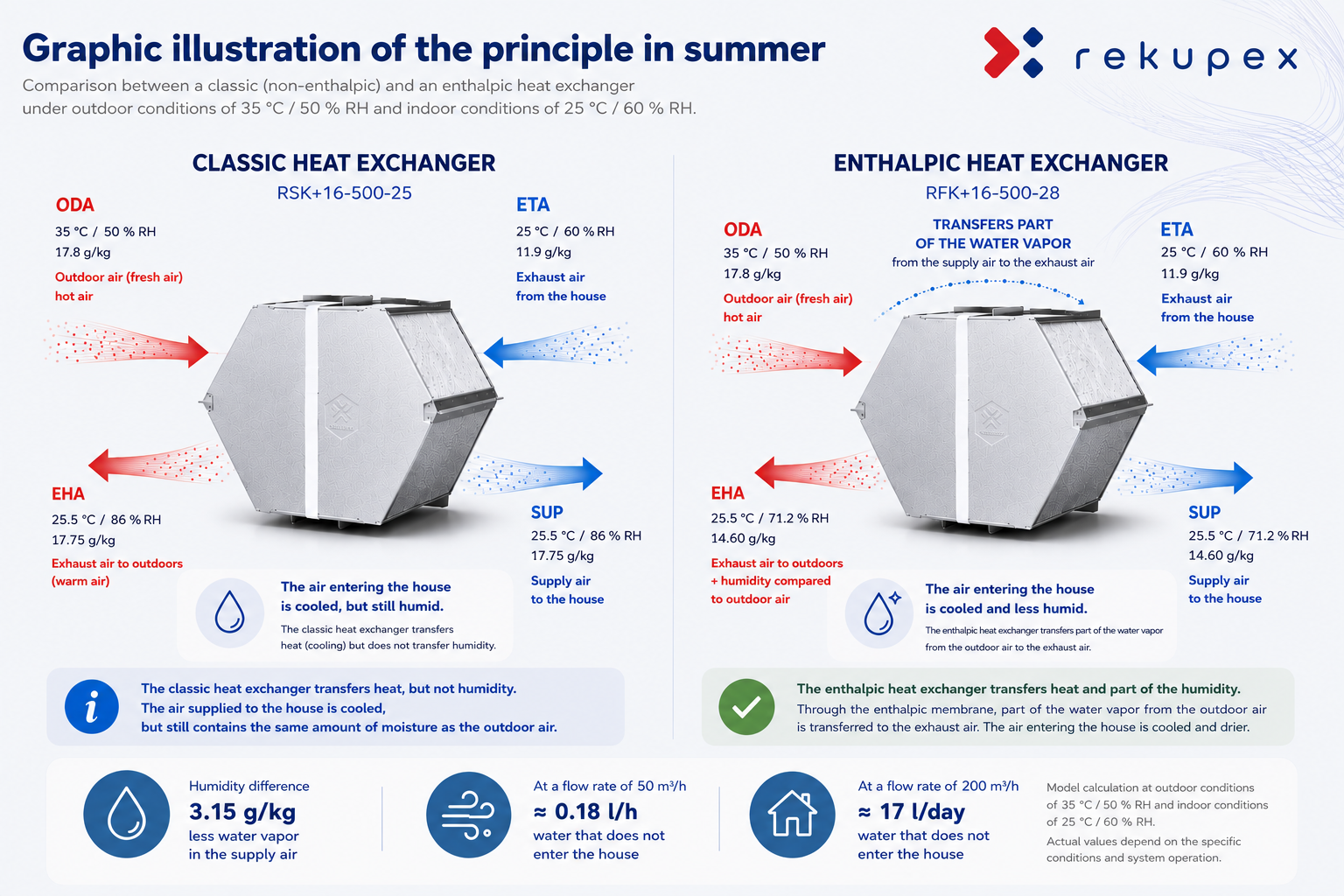
For a clear comparison, we use a summer scenario where it is hot and humid outside and the house is cooled inside.
| Condition | Outdoor Fresh Air | Exhaust Air from the House |
| Temperature | 35 °C | 25 °C |
| Relative Humidity | 50 % RH | 60 % RH |
| Absolute Humidity | 17.8 g/kg | 11.9 g/kg |
| Airflow | 50 m³/h | |
The comparison is based on calculations for two exchangers of the same size:
| Supply Air Parameter | RSK+16-500-25 standard exchanger |
RFK+16-500-28 enthalpy exchanger |
| Supply air temperature | 25.5 °C | 25.5 °C |
| Supply air relative humidity | 86.0 % RH | 71,2 % RH |
| Supply air absolute humidity | 17.75 g/kg | 14.60 g/kg |
| Difference compared to standard exchanger | 0 g/kg | -3.15 g/kg |
At first glance, a value of 3.15 g/kg may seem small. However, a ventilation unit operates many hours a day and brings in tens to hundreds of cubic meters of air every hour. In total, this represents a significant amount of water that would otherwise enter the house.
| Operating Situation | Approximate Amount of Water Kept Out of the House |
| At a flow rate of 50 m³/h | approx. 0.18 l/h |
| At a flow rate of 200 m³/h | approx. 17 l/day |
Practical Significance:
On a model summer day, the enthalpy exchanger can significantly limit the amount of water that would enter the house solely through ventilation at a standard flow rate.
An enthalpy exchanger features a special membrane that allows the transfer of part of the water vapor between two air streams. The direction of moisture transfer is not fixed. It always depends on the current conditions outside and inside the house.
| In winter | the air outside is cold and dry, while the air inside is warmer and more humid – the enthalpy exchanger helps return part of the moisture back into the house |
| In summer | the air outside is often warm and humid, while the house is cooled inside – the enthalpy exchanger helps transfer part of the moisture into the exhaust air |
That is why an enthalpy exchanger is a year-round solution. In winter, it helps against excessively dry air; in summer, it helps against excessive moisture intake from the outside.
| Less moisture from the outside | reduces the amount of water vapor brought into the house by ventilation |
| Lower cooling load | the cooling system does not have to deal with such a high humidity load afterward |
| Higher comfort | the air feels more pleasant and less stuffy |
| Year-round use | helps retain moisture in winter, limits its intake in summer |
| Suitable for modern houses | ideal for houses with mechanical cooling, fan coils, or ceiling cooling |
An enthalpy exchanger is not a condensation dehumidifier or an air conditioner with active dehumidification.
If there is a long-term very high humidity in the house, for example, due to a new build, wet structures, construction moisture, laundry drying, or another strong source of moisture, the enthalpy exchanger alone will not solve the problem immediately.
Its main benefit lies in limiting the intake of new moisture from the outside during ventilation. By doing so, it helps stabilize the indoor climate and reduces the house's humidity load.
| Myth | Reality |
| An enthalpy exchanger increases humidity in the house during summer. | In a typical summer operation with a cooled interior, it conversely limits the intake of moisture from the outside. |
| A standard exchanger is always better in summer. | A standard exchanger transfers coolness, but it still brings moisture from the outdoor air into the house. |
| An enthalpy exchanger only works in winter. | It works year-round. In winter, it helps against dry air; in summer, against the humidity load. |
| If I have cooling, I do not need an enthalpy exchanger. | It makes great sense precisely when cooling, as it reduces the amount of moisture brought in through ventilation. |
Does an enthalpy exchanger make sense in summer too?
Yes. If the outdoor air is warm and humid and the house is cooled inside, the enthalpy exchanger helps reduce the humidity of the supplied air.
Does this mean there will automatically be ideal humidity at home?
Not automatically. The resulting humidity depends on outdoor conditions, ventilation, cooling, and sources of moisture in the house. However, the enthalpy exchanger limits the intake of moisture from the outside.
Should I swap the enthalpy exchanger for a standard one in summer?
In most cases, no. If you are dealing with high humidity in the house, an enthalpy exchanger is advantageous for summer operation.
Will an enthalpy exchanger help with fan coils or ceiling cooling?
Yes. It reduces the humidity load caused by the supplied air, which is very important for cooled houses.
A standard exchanger in summer transfers coolness but does not transfer moisture. Thus, cooled but still humid outdoor air enters the house.
An enthalpy exchanger transfers both coolness and part of the water vapor. Thanks to this, cooled air with lower humidity enters the house.
In the model calculation, the absolute humidity of the supplied air decreased from 17.75 g/kg to 14.60 g/kg. At a standard flow rate, this difference can mean up to approximately 17 liters of water per day that do not enter the house at all.
Therefore, an enthalpy exchanger is a year-round solution: in winter, it helps against dry air; in summer, it helps against an excessive supply of moisture from the outside.
Send us the type of your heat recovery unit or the dimensions of the original exchanger. We will verify compatibility and recommend a suitable solution for year-round operation – both in winter and summer.
We will be happy to help you choose the right enthalpy exchanger for your unit.
Read verified reviews from those who have purchased from us.



Premium replacement enthalpy heat exchanger from the ZERN EC-EX series, fully compatible with Viessmann Vitovent 300-W (400 m³/h, H32S B400) units. It ensures highly efficient heat and moisture recovery thanks to a unique polymer membrane.