

Does an enthalpy heat exchanger reduce humidity in the house in summer?
Enthalpy Exchanger in Summer: Less Humidity, More Comfort
An enthalpy exchanger is not designed only for the winter period. It also plays a very important role in summer, when it helps reduce the amount of humidity brought into the house from the outdoor air.
In winter, the enthalpy exchanger helps return part of the moisture back to the interior, reducing excessively dry air in the house. In summer, however, it can work the opposite way. If the outdoor air is warm and humid and the house is cooled inside, the enthalpy exchanger helps transfer part of the moisture from the incoming outdoor air to the exhaust air from the house.
As a result, cooled air with lower humidity enters the house. This is crucial especially for modern houses with cooling, fan coils, ceiling cooling, or air conditioning, where high humidity significantly reduces thermal comfort.
Why is Humid Air a Problem in Summer?
In summer, we often deal with the opposite problem compared to winter. In winter, the air in the house tends to be too dry. In summer, however, the outdoor air is often warm and very humid at the same time.
| Higher perceived temperature | humid air feels heavy, stuffy, and worsens thermal comfort |
| Higher cooling load | air conditioning, fan coils, or ceiling cooling must handle not only temperature but also humidity |
| Risk of condensation | higher humidity increases the risk of condensation on cold surfaces |
Therefore, it is not enough to only address the temperature of the supplied air. The amount of water vapor brought into the house through ventilation is also important.
Standard Exchanger vs. Enthalpy Exchanger in Summer
| Standard Exchanger | Enthalpy Exchanger |
| transfers coolness from the exhaust air | transfers coolness from the exhaust air |
| barely reduces the humidity of the supplied air | also transfers part of the water vapor |
| Cooled but still humid air enters the house. | Cooled air with lower humidity enters the house. |
A standard exchanger mainly helps with temperature. An enthalpy exchanger helps with both temperature and limiting the humidity brought in from the outside.
Graphical Representation of the Exchanger Principle in Summer
Below is a direct comparison between a standard non-enthalpy exchanger and an enthalpy exchanger in summer operation.
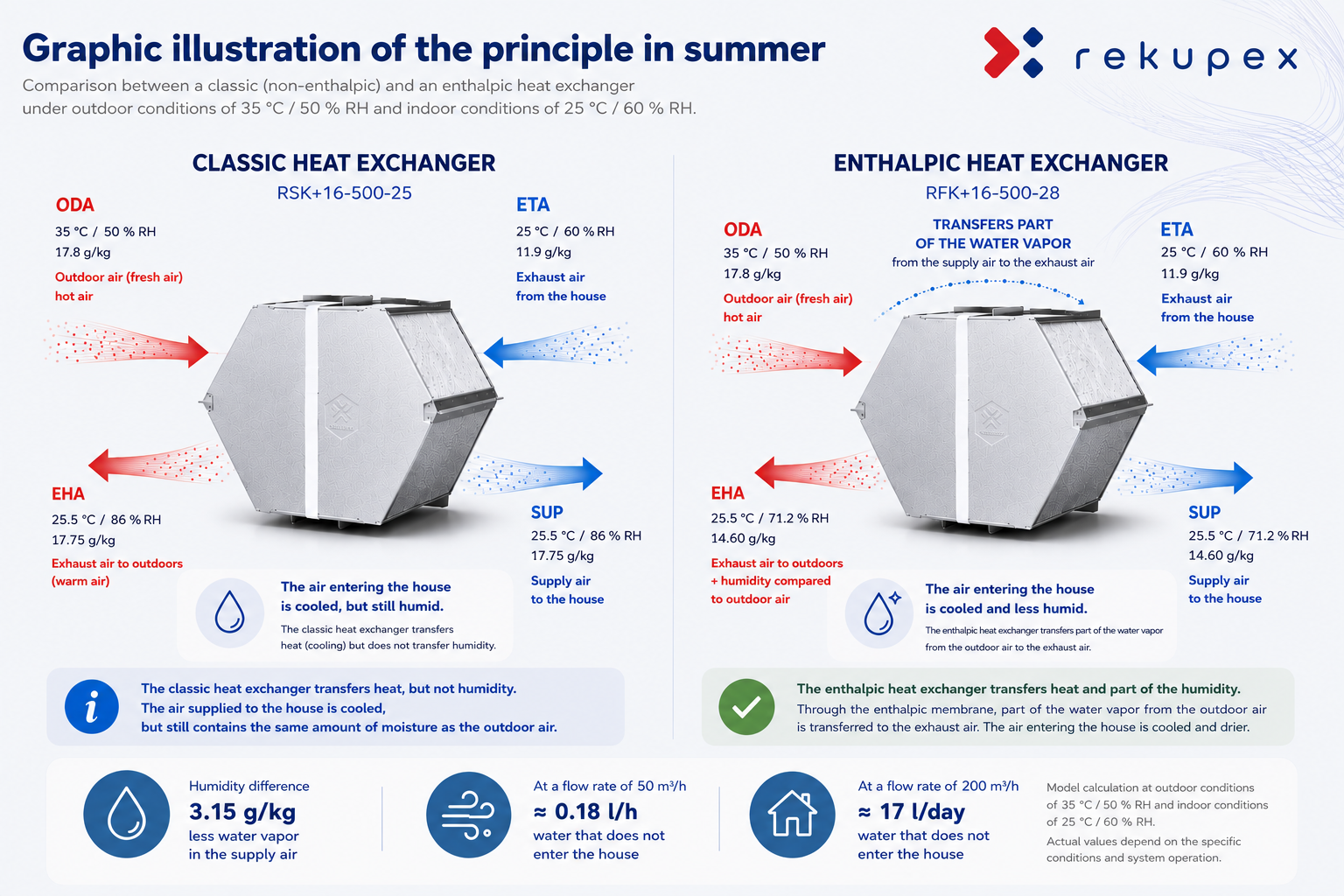
A standard exchanger brings cooled but humid air into the house. An enthalpy exchanger brings cooled air with lower humidity.
Model Input Conditions
For a clear comparison, we use a summer scenario where it is hot and humid outside and the house is cooled inside.
| Condition | Outdoor Fresh Air | Exhaust Air from the House |
| Temperature | 35 °C | 25 °C |
| Relative Humidity | 50 % RH | 60 % RH |
| Absolute Humidity | 17.8 g/kg | 11.9 g/kg |
| Airflow | 50 m³/h | |
Result at the Supply to the House
The comparison is based on calculations for two exchangers of the same size:
- RECUTECH RSK+16-500-25 – standard non-enthalpy exchanger
- RECUTECH RFK+16-500-28 – enthalpy exchanger
| Supply Air Parameter | RSK+16-500-25 standard exchanger |
RFK+16-500-28 enthalpy exchanger |
| Supply air temperature | 25.5 °C | 25.5 °C |
| Supply air relative humidity | 86.0 % RH | 71,2 % RH |
| Supply air absolute humidity | 17.75 g/kg | 14.60 g/kg |
| Difference compared to standard exchanger | 0 g/kg | -3.15 g/kg |
Both exchangers bring air into the house at a similar temperature. The difference lies in the humidity. In this calculation, the enthalpy exchanger reduces the absolute humidity of the supplied air from 17.75 g/kg to 14.60 g/kg.
What Does a Difference of 3.15 g/kg Mean in Practice?
At first glance, a value of 3.15 g/kg may seem small. However, a ventilation unit operates many hours a day and brings in tens to hundreds of cubic meters of air every hour. In total, this represents a significant amount of water that would otherwise enter the house.
| Operating Situation | Approximate Amount of Water Kept Out of the House |
| At a flow rate of 50 m³/h | approx. 0.18 l/h |
| At a flow rate of 200 m³/h | approx. 17 l/day |
Practical Significance:
On a model summer day, the enthalpy exchanger can significantly limit the amount of water that would enter the house solely through ventilation at a standard flow rate.
How Does an Enthalpy Exchanger Transfer Moisture?
An enthalpy exchanger features a special membrane that allows the transfer of part of the water vapor between two air streams. The direction of moisture transfer is not fixed. It always depends on the current conditions outside and inside the house.
| In winter | the air outside is cold and dry, while the air inside is warmer and more humid – the enthalpy exchanger helps return part of the moisture back into the house |
| In summer | the air outside is often warm and humid, while the house is cooled inside – the enthalpy exchanger helps transfer part of the moisture into the exhaust air |
That is why an enthalpy exchanger is a year-round solution. In winter, it helps against excessively dry air; in summer, it helps against excessive moisture intake from the outside.
Main Advantages of an Enthalpy Exchanger in Summer
| Less moisture from the outside | reduces the amount of water vapor brought into the house by ventilation |
| Lower cooling load | the cooling system does not have to deal with such a high humidity load afterward |
| Higher comfort | the air feels more pleasant and less stuffy |
| Year-round use | helps retain moisture in winter, limits its intake in summer |
| Suitable for modern houses | ideal for houses with mechanical cooling, fan coils, or ceiling cooling |
Important Notice
An enthalpy exchanger is not a condensation dehumidifier or an air conditioner with active dehumidification.
If there is a long-term very high humidity in the house, for example, due to a new build, wet structures, construction moisture, laundry drying, or another strong source of moisture, the enthalpy exchanger alone will not solve the problem immediately.
Its main benefit lies in limiting the intake of new moisture from the outside during ventilation. By doing so, it helps stabilize the indoor climate and reduces the house's humidity load.
Myth vs. Reality
| Myth | Reality |
| An enthalpy exchanger increases humidity in the house during summer. | In a typical summer operation with a cooled interior, it conversely limits the intake of moisture from the outside. |
| A standard exchanger is always better in summer. | A standard exchanger transfers coolness, but it still brings moisture from the outdoor air into the house. |
| An enthalpy exchanger only works in winter. | It works year-round. In winter, it helps against dry air; in summer, against the humidity load. |
| If I have cooling, I do not need an enthalpy exchanger. | It makes great sense precisely when cooling, as it reduces the amount of moisture brought in through ventilation. |
Frequently Asked Questions
Does an enthalpy exchanger make sense in summer too?
Yes. If the outdoor air is warm and humid and the house is cooled inside, the enthalpy exchanger helps reduce the humidity of the supplied air.
Does this mean there will automatically be ideal humidity at home?
Not automatically. The resulting humidity depends on outdoor conditions, ventilation, cooling, and sources of moisture in the house. However, the enthalpy exchanger limits the intake of moisture from the outside.
Should I swap the enthalpy exchanger for a standard one in summer?
In most cases, no. If you are dealing with high humidity in the house, an enthalpy exchanger is advantageous for summer operation.
Will an enthalpy exchanger help with fan coils or ceiling cooling?
Yes. It reduces the humidity load caused by the supplied air, which is very important for cooled houses.
Summary
A standard exchanger in summer transfers coolness but does not transfer moisture. Thus, cooled but still humid outdoor air enters the house.
An enthalpy exchanger transfers both coolness and part of the water vapor. Thanks to this, cooled air with lower humidity enters the house.
In the model calculation, the absolute humidity of the supplied air decreased from 17.75 g/kg to 14.60 g/kg. At a standard flow rate, this difference can mean up to approximately 17 liters of water per day that do not enter the house at all.
Therefore, an enthalpy exchanger is a year-round solution: in winter, it helps against dry air; in summer, it helps against an excessive supply of moisture from the outside.
Do You Need Advice on Choosing an Enthalpy Exchanger?
Send us the type of your heat recovery unit or the dimensions of the original exchanger. We will verify compatibility and recommend a suitable solution for year-round operation – both in winter and summer.
We will be happy to help you choose the right enthalpy exchanger for your unit.