


Dry Air in Your Home in Winter? An Enthalpy Heat Exchanger Could Be the Solution
Dry Air in Your Home in Winter? An Enthalpy Heat Exchanger Could Be the Solution
In winter, heat recovery ventilation can supply very dry air to your home. However, an enthalpy heat exchanger can recover part of the moisture from the extract air and return it to the indoor environment.
Dry indoor air is a common problem during the heating season. Cold outdoor air contains only a small amount of water vapour, and when heated to room temperature, its relative humidity drops significantly.
A conventional heat recovery exchanger can transfer heat from the extract air to the fresh supply air very efficiently, but it does not transfer moisture.
An enthalpy heat exchanger, on the other hand, transfers not only heat but also part of the water vapour. This helps maintain more natural indoor humidity, improves living comfort and reduces excessive drying of indoor air.
How significant can the difference be? Let's look at specific technical data from two RECUTECH heat exchangers under identical winter conditions.
Why Is Indoor Air Dry in Winter?
Cold outdoor air contains significantly less water vapour than warm indoor air.
For example, if outdoor air at −5 °C and 78% relative humidity is brought into the house and heated, its water vapour content remains practically unchanged unless moisture is transferred.
However, its relative humidity decreases significantly.
What happens with conventional heat recovery?
Outdoor air enters the heat exchanger with a humidity ratio of approximately 2.0 g/kg.
After passing through the conventional heat exchanger, it reaches a temperature of 19.4 °C in our model example, but still contains only 2.0 g/kg of water vapour.
The resulting relative humidity of the supply air is only 14.6%.
If such air is continuously supplied to the house, indoor humidity may decrease. The actual result also depends on the amount of moisture generated by occupants, cooking, showering and other activities.
How Does an Enthalpy Heat Exchanger Work in Winter?
An enthalpy heat exchanger uses a special membrane that allows the transfer of heat and part of the water vapour between two separate air streams.
During winter, part of the moisture from the warm extract air is transferred to the cold fresh air supplied to the house.
| Heat transfer | Heats fresh outdoor air using heat recovered from the extract air. |
| Moisture transfer | Returns part of the water vapour from the extract air to the supply air. |
| Separation of air streams | The supply and extract air streams remain separate. |
Heated fresh air enters the house with a higher water vapour content than when using a conventional heat exchanger.
Comparison Based on Specific Technical Data
For this illustrative comparison, we used two heat exchangers manufactured by RECUTECH:
| RECUTECH RSK+16-500-25 | Conventional non-enthalpy heat exchanger |
| RECUTECH RFK+16-500-28 | Enthalpy heat exchanger |
Both heat exchangers have dimensions of 366 × 366 × 500 mm. The calculations are based on the manufacturer's technical datasheets under identical inlet conditions.
Model Winter Conditions
The comparison is based on a typical winter situation, with freezing outdoor air and a comfortable indoor temperature.
| Parameter | Outdoor air ODA | Extract air ETA |
| Temperature | −5 °C | 22 °C |
| Relative humidity | 78% RH | 50% RH |
| Humidity ratio | 2.0 g/kg | 8.2 g/kg |
| Nominal airflow | 200 m³/h | |
Supply Air Results – SUP
Both heat exchangers efficiently heat the incoming outdoor air. However, the key difference lies in the amount of water vapour contained in the supply air.
| SUP parameter | Conventional RSK+ | Enthalpy RFK+ |
| Temperature | 19.4 °C | 18.1 °C |
| Relative humidity | 14.6% | 48.3% |
| Humidity ratio | 2.0 g/kg | 6.2 g/kg |
Under these conditions, the enthalpy heat exchanger supplies air to the house with a humidity ratio of 6.2 g/kg, compared with only 2.0 g/kg for the conventional heat exchanger.
The difference is 4.2 g/kg of water vapour in favour of the enthalpy heat exchanger.
What Happens to the Exhaust Air – EHA?
The difference between the heat exchangers is also evident in the air leaving the ventilation unit and being discharged outdoors.
| EHA parameter | Conventional RSK+ | Enthalpy RFK+ |
| Temperature | 5.3 °C | 1.5 °C |
| Relative humidity | 95.1% | 95.1% |
| Humidity ratio | 5.2 g/kg | 4.0 g/kg |
| Calculated condensate | 0.7 l/h | 0.3 l/h |
The enthalpy heat exchanger transfers part of the water vapour from the extract air to the supply air. As a result, the air discharged outdoors is drier, and the amount of condensate produced is lower in this model calculation.
The amount of condensate is not the same as the amount of water vapour recovered and transferred to the supply air. These are two different quantities.
Graphical Illustration of the Principle in Winter
The following illustration clearly demonstrates the difference between conventional and enthalpy heat exchangers under identical inlet conditions.
Comparison of heat and moisture transfer in winter
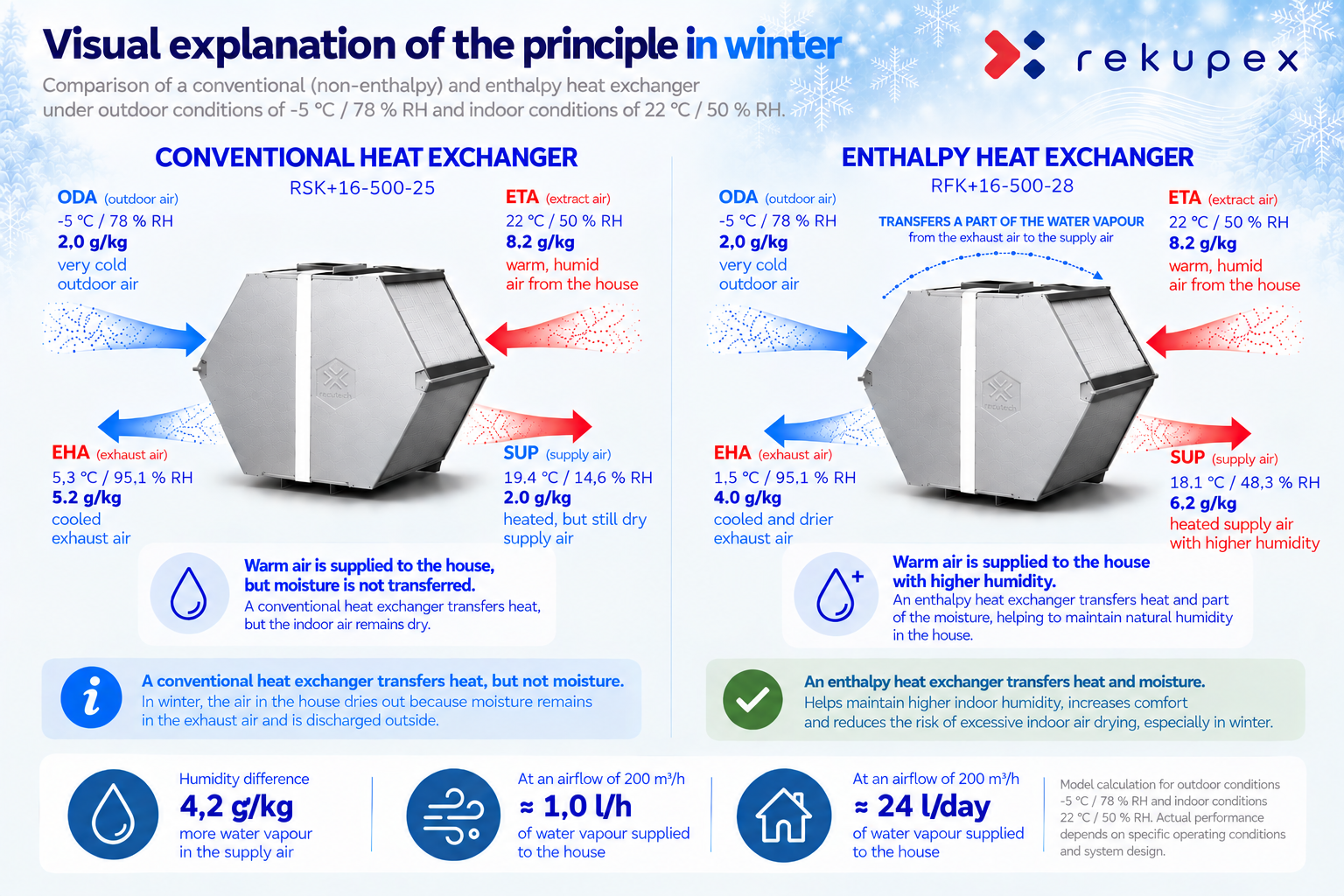
While a conventional heat exchanger transfers heat, an enthalpy heat exchanger transfers both heat and part of the moisture.
How Much Moisture Can an Enthalpy Heat Exchanger Return to Your Home?
At first glance, a difference of 4.2 g/kg may seem small. However, a ventilation unit continuously supplies a large volume of air to the house.
For this model calculation, we use data from the manufacturer's technical datasheets.
Input values:
| Nominal airflow | 200 m³/h |
| Air mass flow rate | 240.8 kg/h |
| SUP humidity ratio – conventional heat exchanger | 2.0 g/kg |
| SUP humidity ratio – enthalpy heat exchanger | 6.2 g/kg |
| Difference in humidity ratio | 4.2 g/kg |
Calculation per hour:
240.8 × 4.2 = 1,011.36 g/h
This corresponds to approximately 1.01 litres of water in the form of water vapour per hour.
Calculation over 24 hours:
1.01136 × 24 = 24.27 l/day
Model comparison result:
≈ 1.0 l/h
More water vapour in the supply air.
≈ 24 l/day
More water vapour supplied to the house during continuous operation.
This is a model comparison under the specified conditions. The value represents the difference in the amount of water vapour supplied to the house compared with a conventional heat exchanger, not the amount of liquid water or a guaranteed increase in indoor humidity. Actual moisture transfer depends on operating conditions, airflow and the available moisture in the extract air.
Main Benefits of an Enthalpy Heat Exchanger in Winter
| Reduced drying of indoor air | Returns part of the moisture from the extract air back into the house. |
| Improved living comfort | Helps maintain more comfortable humidity during the heating season. |
| Heat recovery | Uses heat from the extract air to warm incoming fresh air. |
| Water vapour transfer | A special membrane enables the transfer of part of the moisture between the air streams. |
| Reduced condensate formation | In the model example, less condensate is produced than with the conventional heat exchanger. |
Is an Enthalpy Heat Exchanger Suitable for Your Ventilation Unit?
An enthalpy heat exchanger is not necessarily intended only for new ventilation units. In many existing systems, a conventional heat exchanger can be replaced with a compatible enthalpy heat exchanger.
Our range includes enthalpy heat exchangers for a wide variety of ventilation units from different manufacturers.
Choose a compatible enthalpy heat exchanger for your ventilation unit:
FIND AN ENTHALPY HEAT EXCHANGER FOR YOUR UNIT →
Can't find your ventilation unit?
We will be happy to help you choose a suitable heat exchanger. Send us the manufacturer and exact model of your ventilation unit, and, if possible, attach a photograph or the dimensions of the original heat exchanger.
Contact us: info@rekupex.cz
Conclusion: Heat Recovery Ventilation Doesn't Have to Mean Dry Air
A conventional heat recovery exchanger can recover heat very efficiently, but it does not transfer moisture. In winter, it may therefore supply heated air with very low relative humidity to the house.
An enthalpy heat exchanger transfers not only heat but also part of the water vapour from the extract air back into the supply air.
In our model comparison, at an outdoor temperature of −5 °C, an indoor temperature of 22 °C and 50% relative humidity, the enthalpy heat exchanger supplies approximately 4.2 g/kg more water vapour to the house than the conventional heat exchanger.
At a nominal airflow of 200 m³/h, this corresponds to approximately 24 litres of additional water per day in the form of water vapour in the supply air.
An enthalpy heat exchanger therefore provides an effective way to reduce excessive drying of indoor air during winter while maintaining comfortable ventilation with heat recovery.