
- -32%
Nous proposons un large choix d’échangeurs de chaleur enthalpiques pour la plupart des unités de ventilation avec récupération de chaleur.
Si vous ne trouvez pas le modèle adapté, contactez-nous – nous serons ravis de vous aider !


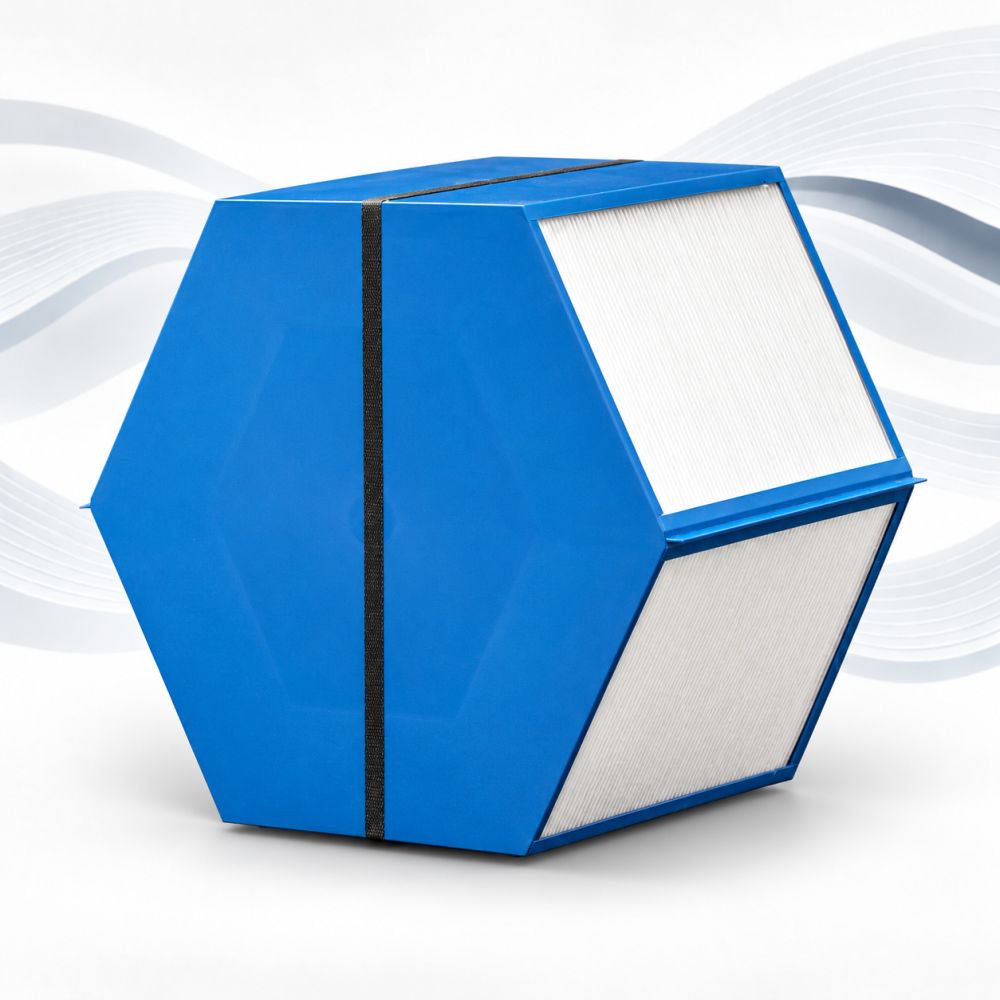
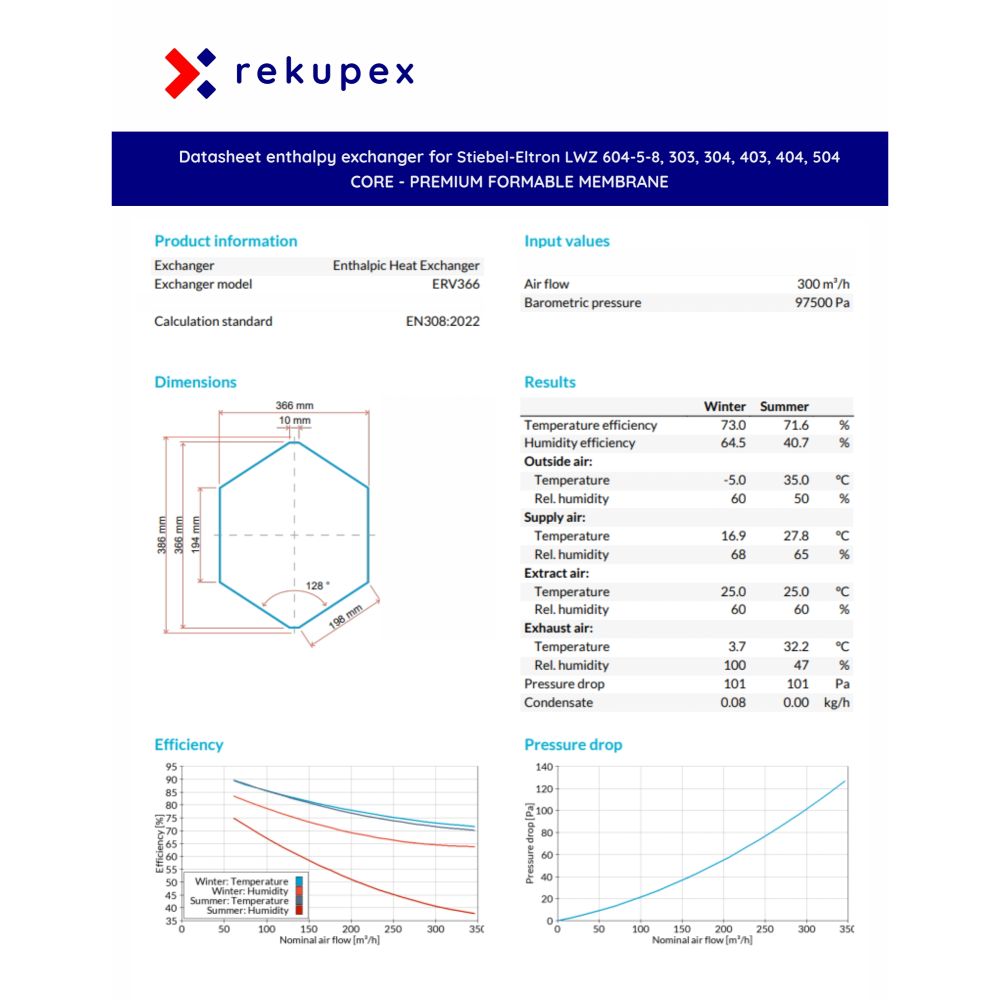
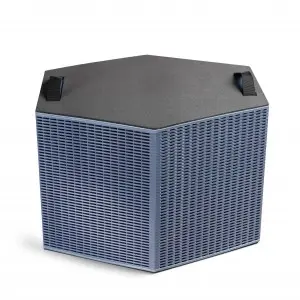
Échangeur enthalpique de remplacement CORE de la gamme F-ERV, fabriqué en Allemagne avec une grande précision. Entièrement compatible avec une sélection d’unités Stiebel-Eltron LWZ 303, 304, 403, 404, 504, LWZ 5 et LWZ 8. Assure une récupération efficace de la chaleur et de l’humidité et contribue à maintenir un climat intérieur confortable sans air excessivement sec.
Cet échangeur enthalpique haut de gamme de la série CORE F-ERV, fabriqué en Allemagne avec une grande précision, est conçu comme un remplacement entièrement compatible pour une sélection d’unités de ventilation Stiebel-Eltron LWZ 303, 304, 403, 404, 504, LWZ 5 et LWZ 8. Il permet de récupérer à la fois la chaleur et l’humidité et contribue ainsi, pendant la saison de chauffage, à limiter l’assèchement excessif de l’air intérieur et à maintenir un climat plus confortable. Ses dimensions et sa conception adaptées permettent un remplacement direct sans modification mécanique de l’unité.
Remarque : Les photos du produit peuvent ne pas représenter exactement la version réelle de l’échangeur. Cet échangeur enthalpique est compatible avec les unités Stiebel-Eltron indiquées ci-dessous. Il ne s’agit toutefois pas d’un échangeur enthalpique d’origine fourni par le fabricant de l’unité. En cas de doute concernant votre choix, nous vous contacterons avant l’expédition afin de vérifier ensemble la compatibilité.
Compatible avec les unités de ventilation Stiebel-Eltron :
| Stiebel-Eltron LWZ 303 | Stiebel-Eltron LWZ 304 flex |
| Stiebel-Eltron LWZ 304 SOL | Stiebel-Eltron LWZ 304 SOL E CH |
| Stiebel-Eltron LWZ 304 Trend | Stiebel-Eltron LWZ 403 |
| Stiebel-Eltron LWZ 403 SOL | Stiebel-Eltron LWZ 404 flex |
| Stiebel-Eltron LWZ 404 SOL | Stiebel-Eltron LWZ 404 Trend |
| Stiebel-Eltron LWZ 504 | Stiebel-Eltron LWZ 504 E |
| Stiebel-Eltron LWZ 5 CS Premium | Stiebel-Eltron LWZ 5 CSE Premium |
| Stiebel-Eltron LWZ 5 S Plus | Stiebel-Eltron LWZ 5 S Trend |
| Stiebel-Eltron LWZ 8 S Trend | Stiebel-Eltron LWZ 604 air |
| Stiebel-Eltron LWZ 604 Enthalpie | Stiebel-Eltron LWZ 8 CS Premium |
| Stiebel-Eltron LWZ 8 CSE Premium | Stiebel-Eltron LWZ 8 CS Trend |
La série CORE F-ERV utilise une technologie de membrane polymère formable. Les principales caractéristiques techniques et valeurs déclarées par le fabricant sont présentées ci-dessous.
| Caractéristique | Avantage technique |
|---|---|
| Technologie F-ERV | Membrane polymère formable destinée au transfert de chaleur et d’humidité. |
| Étanchéité | 100 % des échangeurs sont testés ; le taux de fuite déclaré est inférieur à 1 % du débit d’air nominal. |
| Plage de température | Les matériaux de l’échangeur sont conçus pour une plage de −20 °C à +50 °C. |
| Entretien | La membrane polymère est conçue par le fabricant pour être nettoyable. |
| Normes et certifications | VDI 6022, ÖNORM H 6021, SWKI VA104-01, DIN EN 13501-1, EN ISO 11925, DIN ISO 9001:2015 et UL 723. |
CORE est un leader technologique mondial dans le domaine de la récupération d’énergie et de la fabrication d’échangeurs thermiques et enthalpiques. Depuis 1994, l’entreprise développe et fabrique des échangeurs de haute qualité utilisés dans des systèmes de ventilation dans le monde entier.
La production utilise des technologies modernes telles que le soudage laser et ultrasonique, des systèmes de fabrication robotisés ainsi que ses propres technologies de membranes polymères.
L’objectif de CORE est de contribuer à des environnements intérieurs sains, confortables et économes en énergie grâce à des technologies innovantes et de haute qualité.
L’échangeur enthalpique CORE transmet-il les odeurs ?
Les flux d’air soufflé et extrait sont séparés dans l’échangeur et chaque échangeur est soumis à un contrôle d’étanchéité par le fabricant. CORE annonce un taux de fuite inférieur à 1 % du débit d’air nominal. Toutefois, pour la série F-ERV, le fabricant ne garantit pas une absence absolue de transfert de toutes les substances odorantes ; cette propriété ne peut donc pas être garantie à 100 %.
L’échangeur CORE F-ERV peut-il être nettoyé ?
Oui. Le fabricant indique que la membrane polymère est nettoyable. Lors de l’entretien, respectez les instructions du fabricant et évitez toute méthode susceptible d’endommager la membrane.
Vous souhaitez comparer les différentes technologies ? Consultez notre comparatif des échangeurs enthalpiques.
Vous avez d’autres questions ? Consultez notre rubrique Questions fréquentes (FAQ).
Fiche technique
Références spécifiques
Chez Rekupex, nous proposons des échangeurs enthalpiques pour une large gamme d’unités de ventilation de différents fabricants. Nous élargissons continuellement notre offre afin de couvrir le plus grand nombre possible de systèmes de ventilation couramment utilisés sur le marché.
Nos clients jouent également un rôle important dans le développement de notre gamme en nous aidant à identifier de nouveaux types d’unités de ventilation ainsi que leurs échangeurs enthalpiques compatibles. Grâce à cette coopération, nous pouvons continuellement développer notre offre et l’adapter aux besoins réels des utilisateurs. Merci pour vos retours et suggestions.
Afin de faciliter la compréhension des différences entre les échangeurs enthalpiques des fabricants RECUTECH, ZERN Engineering, CORE et AIRWOODS, nous avons préparé une comparaison technique claire d’échangeurs de même dimension 366 × 366 × 400 mm, qui peuvent être comparés directement grâce à leurs dimensions identiques.
L’aperçu comprend également trois graphiques clés, qui permettent de comparer le comportement des échangeurs en fonction du débit d’air volumique :
Cliquez sur le graphique pour ouvrir le détail en haute résolution.
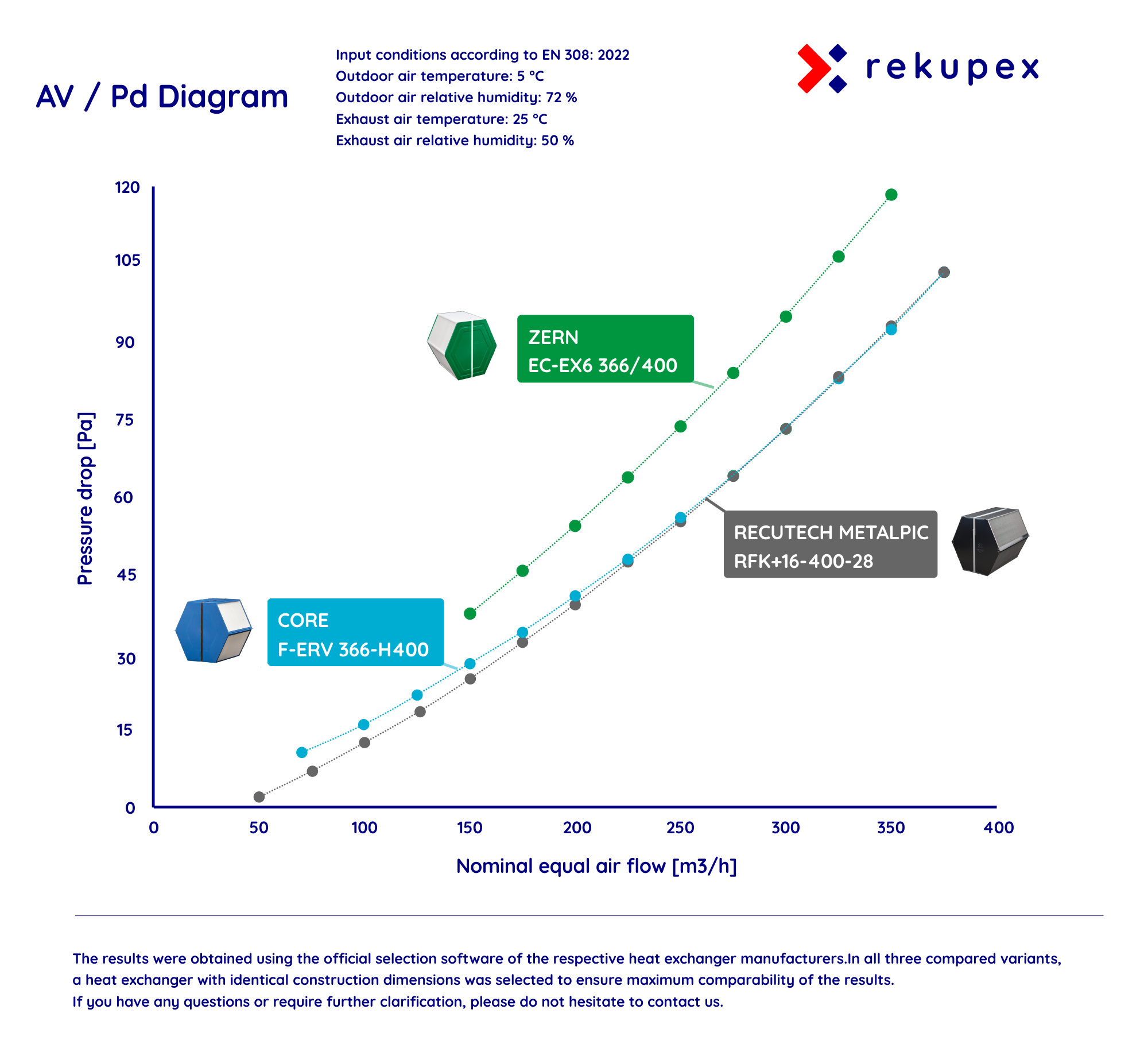
Perte de charge vs. débit d’air volumique
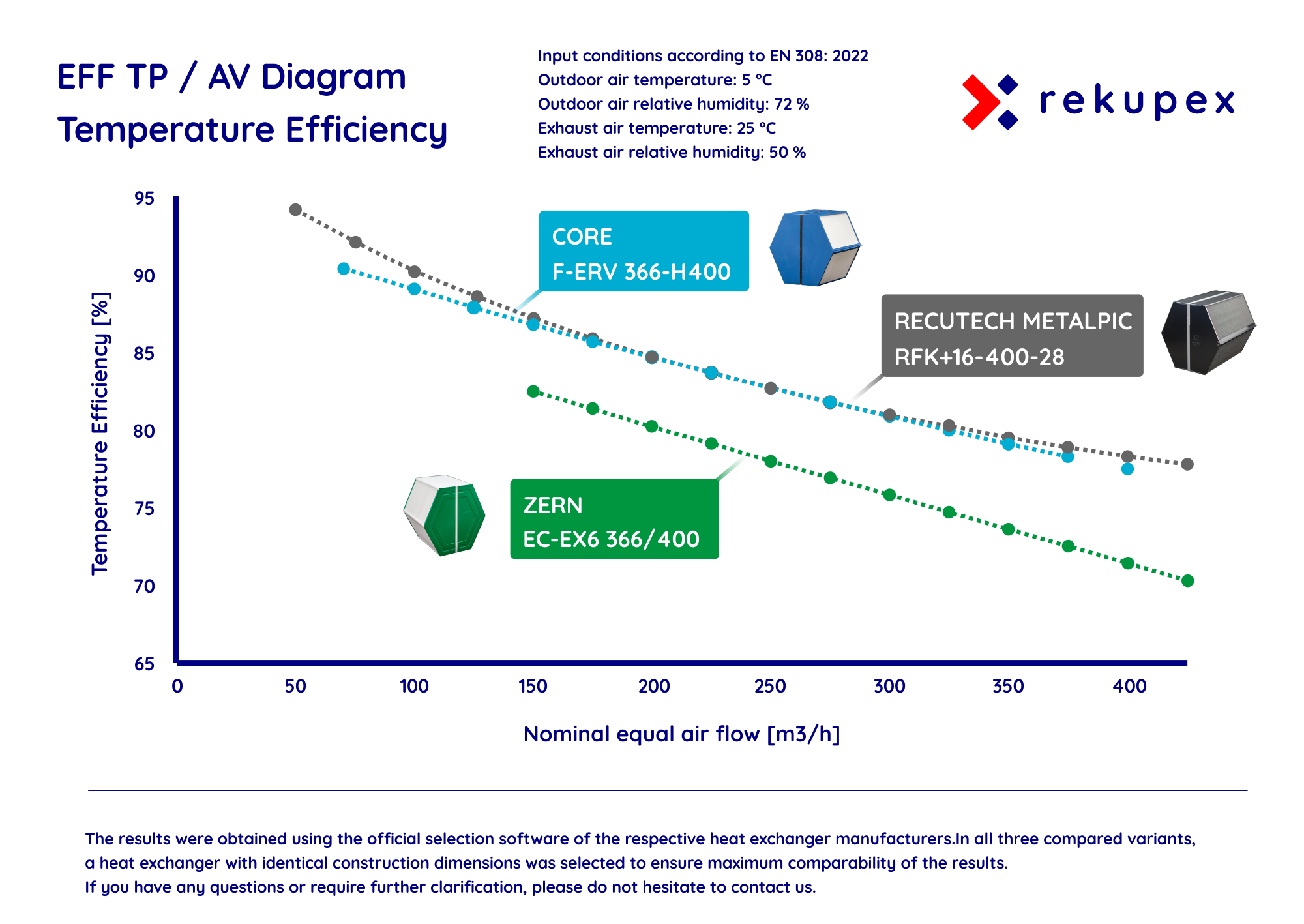
Rendement de transfert de chaleur
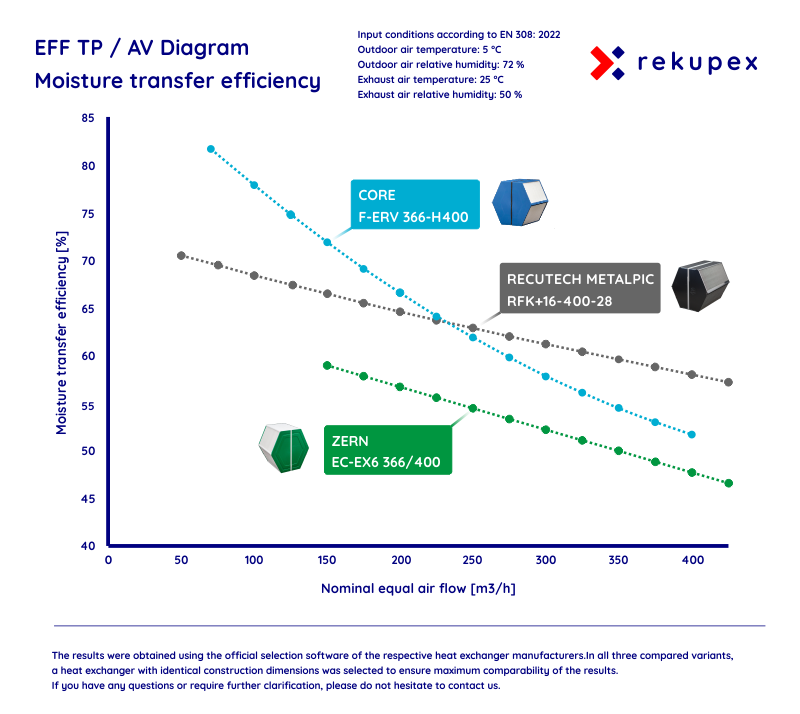
Rendement de transfert d’humidité
Conditions d’entrée selon EN 308:2022
Les résultats ont été obtenus à l’aide des logiciels de sélection et de conception propres à chaque fabricant.
Les paramètres d’entrée sont harmonisés selon la norme EN 308:2022, sauf indication contraire. Dans le cas d’AIRWOODS, des valeurs d’entrée différentes conformes à la documentation du fabricant ont été utilisées, c’est pourquoi les données d’entrée diffèrent.
Sur mobile, faites glisser le tableau latéralement.
| Paramètre | CORE F-ERV 366 | ZERN EC-EX6 366 | RECUTECH METALPIC RKF+16 | AIRWOODS WXL-LB 366* |
|---|---|---|---|---|
| Photo de l’échangeur |  |
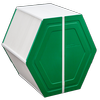 |
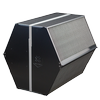 |
 |
| Conditions d’entrée | ||||
| Température de l’air extérieur [°C] | 5 | 5 | 5 | -5 |
| Humidité relative de l’air extérieur [%] | 72 | 72 | 72 | 25 |
| Température de l’air extrait [°C] | 25 | 25 | 25 | 25 |
| Humidité relative de l’air extrait [%] | 50 | 50 | 50 | 80 |
| Paramètres pour un débit d’air volumique de 150 m³/h | ||||
| Perte de charge [Pa]¹ | 28 | 37,65 | 25,18 ⭐ meilleure valeur | 29,9 |
| Rendement thermique [%]¹ | 84,1 | 82,36 | 87,1 ⭐ meilleure valeur | 85,75 |
| Rendement de transfert d’humidité [%]¹ | 70,9 | 58,96 | 66,5 | 75,73 ⭐ meilleure valeur |
| Paramètres pour un débit d’air volumique de 400 m³/h | ||||
| Perte de charge [Pa]¹ | 134 | 141 | 114 ⭐ meilleure valeur | – |
| Rendement thermique [%]¹ | 77,5 | 71,4 | 78,3 ⭐ meilleure valeur | – |
| Rendement de transfert d’humidité [%]¹ | 51,7 | 47,84 | 58 ⭐ meilleure valeur | – |
| Construction et matériaux | ||||
| Matériau du boîtier de l’échangeur | Plastique non spécifié | HPS (High Pressure Structure) | Aluminium résistant à la corrosion | Plastique non spécifié |
| Type de construction de l’échangeur | Échangeur à plaques polymère | Échangeur à plaques polymère | Échangeur enthalpique métallique ⭐ | Échangeur à plaques polymère |
| Support de la membrane enthalpique | La membrane fait partie du matériau support | HPS (High Pressure Structure) | Support en aluminium (métal déployé) | Séparateurs en plastique |
| Type de membrane enthalpique | Membrane polymère formable (intégrée aux plaques) | Membrane polymère microporeuse | Membrane échangeuse d’ions (METALPIC) | Membrane polymère microporeuse |
| Emballage de transport | Protection en polystyrène + carton | Protection en polystyrène + carton | Caisse de transport en bois (également adaptée au stockage de l’échangeur d’origine) | Protection en polystyrène + carton |
| Évaluation REKUPEX | ||||
| Évaluation générale | Rendement élevé à des débits plus faibles. Grâce à son faible poids et à son boîtier lisse, il impose des exigences minimales lors de l’installation. | Construction robuste et mécaniquement durable. Bonne disponibilité des dimensions pour une large gamme d’unités de ventilation. | Échangeur entièrement en aluminium avec membrane METALPIC. Excellent rapport rendement / perte de charge. Rendement de transfert de chaleur le plus élevé et, à des débits d’air plus importants, également un très bon transfert d’humidité. | Échangeurs éprouvés utilisés par de nombreux fabricants européens d’unités grâce à un bon rapport prix / performances. |
| Points forts | Très bon rendement de récupération d’humidité à faibles débits d’air. Faible poids. | Fabrication très solide et grande résistance mécanique. | Très bons résultats à débits moyens et élevés. Faible perte de charge sur toute la plage. | Prix avantageux tout en conservant de bons paramètres. |
| Possibilité d’adapter les dimensions de l’échangeur | Limitée | Limitée | Très larges possibilités d’adaptation des dimensions ⭐ | Limitée |
| Disponibilité des échangeurs nouvellement identifiés et moins courants | Disponibilité limitée | Bonne disponibilité | Très bonne disponibilité ⭐ | Disponibilité limitée |
| Remarque concernant le fabricant | – | – | RECUTECH offre un excellent support technique et commercial, ce qui permet de concevoir, d’adapter et d’intégrer efficacement les échangeurs dans une large gamme d’unités de ventilation. Grâce à leur construction robuste avec boîtier en aluminium, ces échangeurs conviennent également très bien aux applications de rétrofit et à la modernisation d’anciens équipements. | – |
| Certification et conformité | ||||
| Eurovent | – | – | OUI | – |
| DIN ISO 9001:2015 | OUI | OUI | OUI | – |
| Certificat d’hygiène | VDI 6022 | VDI 6022 | VDI 6022 | ANTI BACTERIAL + Antimicrobial test report |
| RoHS | OUI | OUI | OUI | OUI |
| REACH | OUI | OUI | OUI | OUI |
| Source des données et calcul | ||||
| Fabricant de l’échangeur | CORE GmbH | ZERN Engineering | RECUTECH | AIRWOODS |
| Disponibilité (vente) | www.rekupex.cz | www.rekupex.cz www.rekupex.de |
www.rekupex.cz www.rekupex.de |
Sur demande par e-mail : info@rekupex.cz |
| Dimension calculée | 366 × 366 × 400 mm | 366 × 366 × 400 mm | 366 × 366 × 400 mm | 366 × 366 × 400 mm |
| Logiciel de calcul | En ligne (site web du fabricant) | En ligne (site web du fabricant) | Sélecteur de conception hors ligne | Sélecteur de conception hors ligne |
| Date du calcul | 3 mars 2026 | 3 mars 2026 | 3 mars 2026 | 3 mars 2026 |
⭐ meilleure valeur dans la catégorie donnée
¹ Les valeurs ont été déterminées sur la base de calculs effectués dans les logiciels de sélection des fabricants, dans les conditions d’entrée définies par la norme EN 308:2022.
* Des valeurs d’entrée différentes, selon la documentation du fabricant, ont été utilisées pour AIRWOODS.
Sur la base de notre longue expérience dans la conception et l’intégration d’échangeurs enthalpiques dans différents types d’unités de ventilation, nous recommandons tout particulièrement les échangeurs RECUTECH, qui se distinguent par leur très bon rapport rendement / perte de charge, leur construction robuste et surtout par l’excellent support technique du fabricant.
Grâce à cette coopération, les échangeurs peuvent être facilement adaptés à une large gamme d’unités de ventilation, y compris pour des installations de rétrofit dans des équipements plus anciens.
La comparaison montre que les différents fabricants optimisent leurs échangeurs pour des conditions de fonctionnement différentes. Certains échangeurs obtiennent de très bons résultats surtout à faibles débits d’air volumiques, tandis que d’autres sont optimisés pour des débits d’air moyens et plus élevés.
Lors du choix d’un échangeur enthalpique, il est donc important de prendre en compte non seulement le rendement lui-même, mais aussi la perte de charge, la construction de l’échangeur, la compatibilité avec l’unité de ventilation, la possibilité d’adapter les dimensions ainsi que la disponibilité des échangeurs de remplacement.
Quelle est la différence entre un échangeur enthalpique et un échangeur de récupération de chaleur standard ?
Un échangeur enthalpique transfère non seulement la chaleur, mais aussi une partie de l’humidité de l’air extrait vers l’air soufflé. Cela permet de maintenir un niveau d’humidité intérieure plus confortable, en particulier pendant la saison hivernale.
Quel est le rendement typique d’un échangeur enthalpique ?
Le rendement thermique des échangeurs enthalpiques modernes se situe généralement approximativement entre 75–90 %.
Le rendement de transfert d’humidité est généralement plus faible et se situe le plus souvent autour de 40–75 %.
Ces deux valeurs dépendent fortement de la conception de l’échangeur, de la qualité de la membrane et surtout du débit d’air volumique auquel l’échangeur fonctionne.
Peut-on installer un échangeur enthalpique dans une ancienne unité de ventilation ?
Oui, chez RekupeX, nous ne faisons pas que vendre des échangeurs, nous les adaptons également techniquement à des unités de ventilation spécifiques. Nous fabriquons nos propres profils d’étanchéité et de fixation, et si nécessaire nous produisons également des caissons de réduction. Grâce à cela, nous pouvons proposer un échangeur enthalpique de remplacement même pour des unités de ventilation plus anciennes, pour lesquelles la compatibilité peut sembler problématique à première vue. Les échangeurs pour les unités Atrea en sont un exemple typique.
Remarque : Les données techniques et les graphiques présentés dans cet aperçu ont été préparés sur la base de la documentation technique des différents fabricants ainsi que des résultats de leurs outils de sélection ou de conception. Bien que nous ayons mis tout en œuvre pour garantir une précision maximale, certaines valeurs peuvent varier en fonction des conditions de fonctionnement spécifiques, de la configuration de l’unité ou des mises à jour des données fournies par les fabricants.
L’évaluation REKUPEX indiquée repose sur notre longue expérience pratique dans la conception, la vente et l’intégration d’échangeurs enthalpiques dans différents types d’unités de ventilation.
Si un fabricant constate une inexactitude ou a un commentaire concernant les données indiquées, nous lui serons reconnaissants de nous en informer et nous serons heureux d’ajuster les données.
Si vous n’êtes pas sûr de l’échangeur enthalpique adapté à votre unité de ventilation, n’hésitez pas à nous contacter. Nous serons ravis de vous aider à choisir la bonne solution.
Non, ne bouchez jamais l’évacuation des condensats.
Même si les échangeurs enthalpiques produisent très peu de condensat grâce au transfert d’humidité, du condensat peut apparaître en cas de fortes gelées et d’une certaine humidité. Boucher l’évacuation pourrait endommager irréversiblement l’unité de ventilation.
Parce qu’un échangeur enthalpique transfère également l’humidité, on pourrait penser que le risque de formation de moisissures est plus élevé. En réalité, toute l’humidité est évacuée avec l’air frais, donc le risque de formation de moisissures n’existe pas.
Notre recommandation est de ne jamais éteindre l’unité pendant les mois d’hiver, afin que l’évacuation de l’humidité soit assurée en continu. Si vous devez néanmoins arrêter l’unité, retirez l’échangeur, rincez-le à l’eau propre, séchez-le soigneusement puis remettez-le en place.
Oui, l’installation n’est pas compliquée. Il suffit de suivre le mode d’emploi de votre unité de ventilation. Comme pour un échangeur classique, il est nécessaire de le retirer de temps en temps pour le nettoyer – la procédure est identique, vous remplacez simplement l’échangeur d’origine par l’échangeur enthalpique.
N’hésitez pas à nous contacter avec n’importe quel modèle d’unité. Nous ferons tout notre possible pour vous fournir un échangeur 100 % compatible, quel que soit votre système de ventilation.
Les échangeurs proposés par RekupeX sont des produits de remplacement fabriqués par des fabricants spécialisés d'échangeurs de chaleur tels que RECUTECH, ZERN, CORE et d'autres.
Lorsqu'un produit est indiqué comme compatible avec une unité spécifique de récupération de chaleur ou de ventilation, il est destiné à être utilisé dans les modèles mentionnés sur la page du produit, en tenant compte des dimensions, de la conception et des exigences d'installation correspondantes.
Sauf indication contraire explicite, ces produits ne sont pas des pièces de rechange d'origine fournies par le fabricant de l'unité de ventilation.
Les noms des fabricants, les marques et les désignations des modèles d'unités de ventilation sont utilisés exclusivement pour identifier l'usage prévu et la compatibilité du produit de remplacement proposé.
Un échangeur enthalpique est conçu pour une utilisation toute l’année. En hiver, il empêche l’air de devenir trop sec, et en été, il aide à maintenir une humidité et une température agréables en réduisant le transfert de chaleur et en restituant une partie de l’humidité à l’air frais. Cela améliore le confort et permet d’économiser de l’énergie toute l’année.
L’entretien d’un échangeur enthalpique n’est pas plus exigeant que celui d’un échangeur classique. Les instructions sont décrites dans le manuel et dans notre guide vidéo. En résumé : aspirez d’abord l’échangeur avec une brosse douce, puis rincez-le à l’eau propre (max. 50 °C). N’utilisez jamais d’air comprimé ni de nettoyeur haute pression.
Après le rinçage, laissez toute l’eau s’écouler. L’humidité restante peut être éliminée délicatement avec un sèche-cheveux, mais uniquement avec de l’air froid. Une fois complètement sec, remettez l’échangeur dans la même orientation.
Les produits chimiques ne sont pas recommandés. En cas de besoin de désinfection, vous pouvez utiliser une solution faible d’acide peracétique (0,1–0,2 %), suivie d’un rinçage abondant.
Oui, l’utilisation d’un échangeur enthalpique est totalement sûre. La membrane est conçue pour ne laisser passer que les molécules de vapeur d’eau, tout en empêchant le passage des bactéries, des odeurs et des substances nocives. Tous les échangeurs enthalpiques que nous proposons sont testés et certifiés du point de vue de l’hygiène.
L’utilisation d’un échangeur enthalpique contribue toujours à améliorer les conditions d’humidité intérieure, car une partie de l’humidité de l’air extrait est restituée à l’air neuf. Il n’est malheureusement pas possible de garantir l’atteinte de valeurs idéales (généralement 40–60 %), car l’humidité finale dépend également d’autres facteurs – par exemple le mode d’utilisation du logement, le nombre d’occupants, les sources naturelles d’humidité ainsi que les conditions climatiques extérieures.
Nous garantissons toutefois une amélioration du niveau d’humidité, car la récupération de l’humidité de l’air extrait augmente naturellement son niveau à l’intérieur.
La lamelle de l’échangeur enthalpique fonctionne de la même manière des deux côtés, l’orientation de la lamelle elle-même n’a donc pas d’importance. Il est cependant essentiel que, lors du nettoyage et de la remise en place, l’échangeur soit toujours installé dans la même orientation, afin que les canaux d’air neuf restent destinés à l’air neuf et que les canaux d’air extrait restent destinés à l’air extrait.
Un échangeur enthalpique ne crée pas d’humidité – il ne fait que transférer, dans la mesure du possible, l’humidité de l’air extrait vers l’air neuf. Si vous utilisiez auparavant un échangeur classique, non seulement l’air, mais aussi les structures du bâtiment (murs, plafonds, sols) et les objets poreux ont été asséchés. C’est pourquoi le retour de l’humidité peut prendre plus de temps et nécessite de la patience.
Chaque échangeur enthalpique que nous fournissons est 100 % fonctionnel et une amélioration est toujours garantie. Nous recommandons de maintenir les sources naturelles d’humidité (plantes, cuisine, séchage du linge). Si vous utilisez des humidificateurs, laissez-les fonctionner jusqu’à ce que l’humidité atteigne un niveau acceptable grâce à l’échangeur enthalpique. Ensuite, vous pouvez progressivement réduire leur utilisation.
Oui. Contrairement à un échangeur classique, un échangeur enthalpique restitue une partie de l’humidité à l’air neuf. Ce processus est progressif, mais il peut être accéléré par un apport supplémentaire d’humidité – de manière naturelle (plantes, séchage du linge, lavage des sols) ou à l’aide d’humidificateurs. Une fois que l’humidité revient durablement à des valeurs optimales, il est possible de réduire l’humidification.
Non, un échangeur enthalpique ne crée pas d’humidité par lui-même. Il ne fait que transférer une partie de l’humidité de l’air extrait vers l’air neuf. Si l’humidité dans la maison est trop élevée, il est nécessaire de rechercher d’autres causes (par exemple une ventilation insuffisante, le séchage du linge sans aération ou l’humidité de construction). Un échangeur enthalpique maintient un niveau d’humidité équilibré et aide à éviter les extrêmes.
Un échangeur enthalpique fonctionne sur le principe du flux d’air à contre-courant. Lors de la ventilation, deux flux d’air séparés s’y rencontrent – l’air extrait chaud et humide provenant de l’intérieur et l’air frais froid provenant de l’extérieur. Une membrane spéciale permet le transfert de chaleur et de vapeur d’eau de l’air extrait vers l’air neuf, sans que les deux flux ne se mélangent. Grâce à cela, l’air frais revient dans la maison avec une température et une humidité plus agréables, ce qui améliore le confort tout en économisant de l’énergie
Le joint d’étanchéité doit être collé sur le pourtour de l’échangeur de manière à ce qu’une fois inséré, il s’appuie fermement contre les parois de l’unité et empêche l’aspiration d’air parasite. La surface de l’échangeur doit être sèche et propre avant l’application. Le joint doit toujours être posé de manière droite, sans interruption et sans plis, afin d’assurer une étanchéité correcte.
Attention : Appliquez le joint d’étanchéité uniquement sur les échangeurs où il est également présent sur l’échangeur d’origine de votre unité. Voir notre manuel d’utilisation.
Oui, un échangeur enthalpique est capable de restituer une partie de l’humidité de l’air extrait vers l’air neuf, augmentant ainsi l’humidité intérieure. Il ne s’agit pas seulement d’une propriété théorique – cet effet a également été confirmé en conditions réelles.
Dans un test indépendant réalisé par un utilisateur expérimenté dans sa maison équipée d’une unité de ventilation AEREX, l’air très sec constituait un problème de longue date, malgré les efforts pour l’humidifier naturellement, par exemple à l’aide de plantes.
Après l’installation de l’échangeur enthalpique RECUTECH METALPIC, une augmentation mesurable de l’humidité intérieure ainsi qu’une amélioration globale du confort de vie ont été constatées.
Dans des conditions normales, l’humidité augmente d’environ 10 à 15 % pendant la saison de chauffage. Dans des conditions idéales, l’augmentation peut atteindre 25 à 30 %, en fonction de l’humidité intérieure, des débits d’air et de la construction du bâtiment.
Mesure réelle de l’humidité dans une maison avec échangeur enthalpique
Il est important de comprendre que l’échangeur enthalpique ne crée pas d’humidité, mais la restitue à partir de l’air extrait. Par conséquent, l’effet n’apparaît pas immédiatement, mais progressivement sur plusieurs jours à semaines.
Ce principe correspond aux lois physiques et à une longue expérience pratique. C’est pourquoi les échangeurs enthalpiques constituent une solution adaptée pour les maisons où la ventilation provoque un assèchement excessif de l’air.
C’est précisément pour cette raison que l’échangeur enthalpique est l’une des solutions les plus efficaces contre l’air sec dans les maisons équipées de systèmes de ventilation.
L'échangeur enthalpique n'est pas destiné uniquement à la période hivernale. Il remplit également une fonction très importante en été, en aidant à réduire la quantité d'humidité apportée dans la maison par l'air extérieur.
En hiver, l'échangeur enthalpique aide à restituer une partie de l'humidité à l'intérieur et limite l'air trop sec dans la maison. En été, cependant, il peut fonctionner dans le sens inverse. Si l'air extérieur est chaud et humide et que l'intérieur de la maison est climatisé, l'échangeur enthalpique aide à transférer une partie de l'humidité de l'air neuf vers l'air extrait de la maison.
Le résultat est que l'air entrant dans la maison est refroidi et présente une humidité plus faible. Cela est essentiel notamment dans les maisons modernes équipées de climatisation, de ventilo-convecteurs, de plafonds rafraîchissants ou de climatiseurs, où une humidité élevée réduit considérablement le confort thermique.
En été, nous rencontrons souvent le problème inverse de celui de l'hiver. En hiver, l'air de la maison a tendance à être trop sec. En été, en revanche, l'air extérieur est souvent chaud et en même temps très humide.
| Température ressentie plus élevée | l'air humide paraît lourd, étouffant et dégrade le confort thermique |
| Charge de refroidissement plus élevée | la climatisation, les ventilo-convecteurs ou le plafond rafraîchissant doivent gérer non seulement la température, mais aussi l'humidité |
| Risque de condensation | une humidité plus élevée augmente le risque de condensation sur les surfaces froides |
Il ne suffit donc pas de se préoccuper uniquement de la température de l'air soufflé. La quantité de vapeur d'eau que nous introduisons dans la maison par la ventilation est également importante.
| Échangeur classique | Échangeur enthalpique |
| transfère le froid de l'air extrait | transfère le froid de l'air extrait |
| ne réduit presque pas l'humidité de l'air soufflé | transfère également une partie de la vapeur d'eau |
| L'air qui entre dans la maison est refroidi, mais reste humide. | L'air qui entre dans la maison est refroidi et présente une humidité plus faible. |
Vous trouverez ci-dessous une comparaison directe entre un échangeur classique non enthalpique et un échangeur enthalpique en fonctionnement estival.

Pour une comparaison illustrative, nous utilisons une situation estivale où l'air extérieur est chaud et humide et où l'intérieur de la maison est climatisé.
| Paramètre | Air frais extérieur | Air extrait de la maison |
| Température | 35 °C | 25 °C |
| Humidité relative | 50 % RH | 60 % RH |
| Humidité absolue | 17,8 g/kg | 11,9 g/kg |
| Débit d'air | 50 m³/h | |
La comparaison se base sur le calcul pour deux échangeurs de même taille :
| Paramètre de l'air soufflé | RSK+16-500-25 échangeur classique |
RFK+16-500-28 échangeur enthalpique |
| Température de l'air soufflé | 25,5 °C | 25,5 °C |
| Humidité relative de l'air soufflé | 86,0 % RH | 71,2 % RH |
| Humidité absolue de l'air soufflé | 17,75 g/kg | 14,60 g/kg |
| Différence par rapport à l'échangeur classique | 0 g/kg | -3,15 g/kg |
À première vue, la valeur de 3,15 g/kg peut sembler faible. Or, la centrale de ventilation fonctionne de nombreuses heures par jour et apporte chaque heure des dizaines, voire des centaines de mètres cubes d'air. Au total, cela représente une quantité d'eau importante qui, sinon, pénétrerait dans la maison.
| Situation d'exploitation | Quantité d'eau approximative qui n'entre pas dans la maison |
| À un débit de 50 m³/h | env. 0,18 l/h |
| À un débit de 200 m³/h | env. 17 l/jour |
Signification pratique :
Lors d'une journée d'été type, l'échangeur enthalpique, à débit courant, peut réduire de manière significative la quantité d'eau qui entrerait dans la maison par la seule ventilation.
L'échangeur enthalpique possède une membrane spéciale qui permet le transfert d'une partie de la vapeur d'eau entre les deux flux d'air. Le sens du transfert d'humidité n'est pas fixe. Il dépend toujours des conditions actuelles à l'extérieur et à l'intérieur de la maison.
| En hiver | l'air extérieur est froid et sec, l'air intérieur est plus chaud et plus humide – l'échangeur enthalpique aide à restituer une partie de l'humidité à la maison |
| En été | l'air extérieur est souvent chaud et humide, la maison est climatisée à l'intérieur – l'échangeur enthalpique aide à transférer une partie de l'humidité vers l'air extrait |
C'est pourquoi l'échangeur enthalpique est une solution valable toute l'année. En hiver, il aide contre l'air trop sec, en été, il aide contre l'apport excessif d'humidité venant de l'extérieur.
| Moins d'humidité venant de l'extérieur | limite la quantité de vapeur d'eau apportée dans la maison par la ventilation |
| Charge de refroidissement réduite | le système de refroidissement n'a pas à gérer ensuite une charge d'humidité aussi élevée |
| Confort accru | l'air paraît plus agréable et moins étouffant |
| Utilisation toute l'année | en hiver, il aide à conserver l'humidité, en été, il en limite l'apport |
| Adapté aux maisons modernes | idéal pour les maisons équipées d'un refroidissement mécanique, de ventilo-convecteurs ou d'un plafond rafraîchissant |
L'échangeur enthalpique n'est ni un déshumidificateur à condensation ni un climatiseur avec déshumidification active.
Si la maison présente durablement une humidité très élevée, par exemple en raison d'une construction neuve, de structures humides, d'humidité de construction, du séchage du linge ou d'une autre source importante d'humidité, l'échangeur enthalpique seul ne résoudra pas immédiatement le problème.
Son principal avantage réside dans le fait qu'il limite, lors de la ventilation, l'apport de nouvelle humidité venant de l'extérieur. Il aide ainsi à stabiliser le climat intérieur et réduit la charge d'humidité de la maison.
| Mythe | Réalité |
| L'échangeur enthalpique augmente l'humidité de la maison en été. | Dans un fonctionnement estival typique avec un intérieur climatisé, il limite au contraire l'apport d'humidité venant de l'extérieur. |
| En été, l'échangeur classique est toujours préférable. | L'échangeur classique transfère le froid, mais continue d'apporter l'humidité de l'air extérieur dans la maison. |
| L'échangeur enthalpique ne fonctionne qu'en hiver. | Il fonctionne toute l'année. En hiver, il aide contre l'air sec, en été contre la charge d'humidité. |
| Si j'ai la climatisation, je n'ai pas besoin d'échangeur enthalpique. | C'est justement avec la climatisation qu'il est très utile, car il réduit la quantité d'humidité apportée par la ventilation. |
L'échangeur enthalpique est-il utile également en été ?
Oui. Si l'air extérieur est chaud et humide et que la maison est climatisée à l'intérieur, l'échangeur enthalpique aide à réduire l'humidité de l'air soufflé.
Cela signifie-t-il que la maison aura automatiquement une humidité idéale ?
Pas automatiquement. L'humidité finale dépend des conditions extérieures, de la ventilation, de la climatisation et des sources d'humidité présentes dans la maison. L'échangeur enthalpique limite cependant l'apport d'humidité venant de l'extérieur.
Dois-je remplacer mon échangeur enthalpique par un échangeur classique en été ?
Dans la plupart des cas, non. Si vous êtes confronté à une humidité élevée dans la maison, l'échangeur enthalpique est avantageux pour le fonctionnement estival.
L'échangeur enthalpique aide-t-il avec les ventilo-convecteurs ou le plafond rafraîchissant ?
Oui. Il réduit la charge d'humidité apportée par l'air soufflé, ce qui est très important dans les maisons climatisées.
L'échangeur classique transfère le froid en été, mais ne transfère pas l'humidité. L'air extérieur qui pénètre dans la maison est donc refroidi, mais reste humide.
L'échangeur enthalpique transfère le froid ainsi qu'une partie de la vapeur d'eau. Grâce à cela, l'air qui pénètre dans la maison est refroidi et présente une humidité plus faible.
Dans le calcul modèle, l'humidité absolue de l'air soufflé a diminué de 17,75 g/kg à 14,60 g/kg. À débit courant, cette différence peut représenter jusqu'à environ 17 litres d'eau par jour qui ne pénètrent pas du tout dans la maison.
L'échangeur enthalpique est donc une solution valable toute l'année : en hiver, il aide contre l'air sec, en été, il aide contre l'apport excessif d'humidité venant de l'extérieur.
Envoyez-nous le type de votre centrale de récupération de chaleur ou les dimensions de l'échangeur d'origine. Nous vérifierons la compatibilité et vous recommanderons la solution adaptée pour un fonctionnement toute l'année – en hiver comme en été.
Nous serons heureux de vous aider à choisir l'échangeur enthalpique adapté à votre centrale.
Lisez les avis vérifiés de ceux qui ont acheté chez nous.
acheté chez nous. Tous les avis



Échangeur enthalpique de remplacement CORE de la gamme F-ERV, fabriqué en Allemagne avec une grande précision. Entièrement compatible avec une sélection d’unités Stiebel-Eltron LWZ 303, 304, 403, 404, 504, LWZ 5 et LWZ 8. Assure une récupération efficace de la chaleur et de l’humidité et contribue à maintenir un climat intérieur confortable sans air excessivement sec.